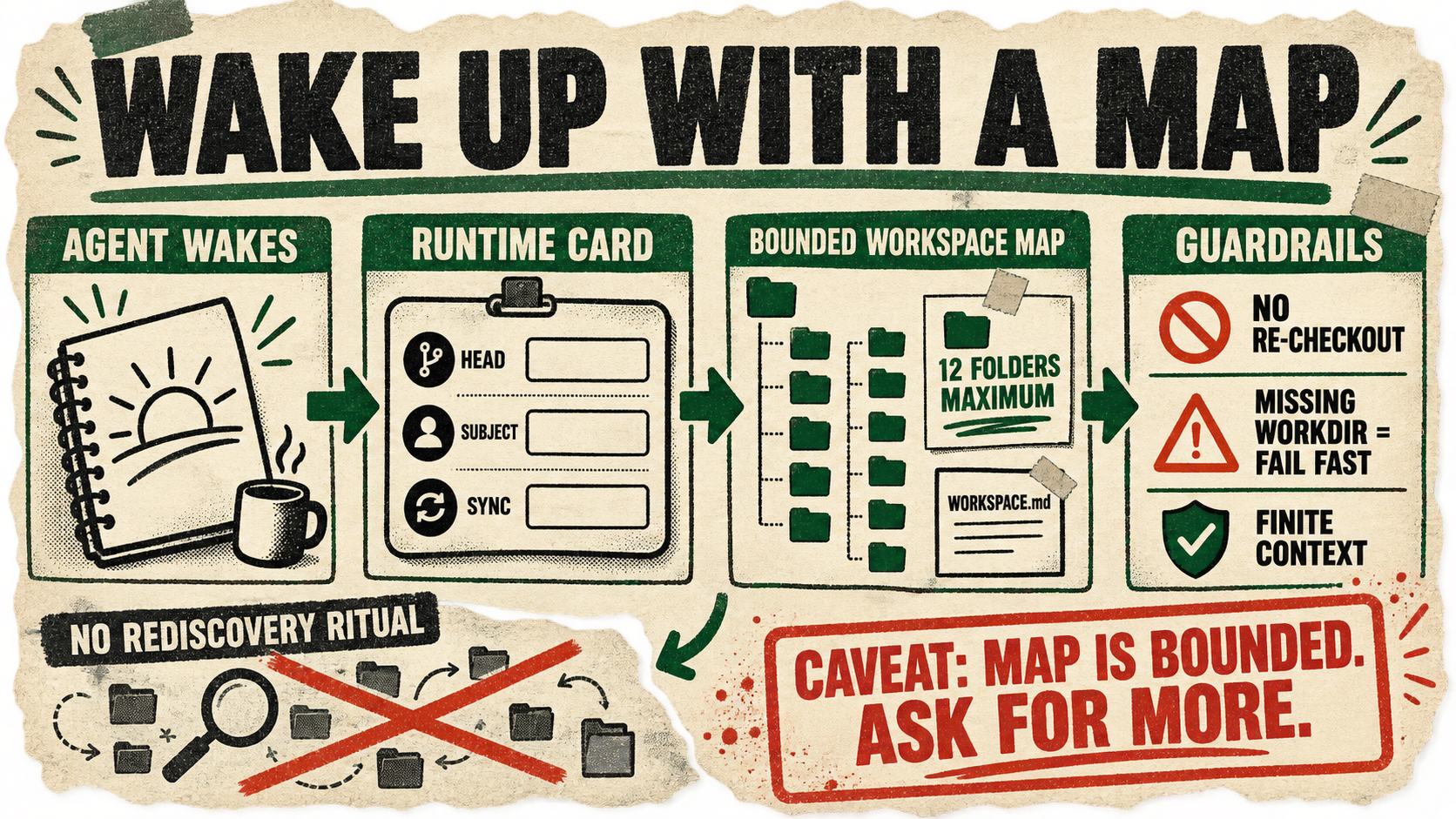
A persistent agent does not merely resume work; it wakes into a question: has the runtime changed, where is the task, and which of its old assumptions still hold? If the answer is always “inspect the filesystem again,” a durable agent can spend its freshest context reconstructing facts it already had.
Headlong is unusually public about trying to solve that problem with coding agents in the loop. Laude’s project update says Audel works in its own fork and that more than 50 of its coding commits have been merged into Headlong. The new wake-prompt commit is credited to Nick Jalbert with a Claude Fable co-author trailer. That is meaningful public evidence of agent-assisted engineering around the project, though it is not proof that this particular patch was written autonomously.
Orientation needs a freshness signal
The engineering is more substantial than a new sentence in a system prompt. In its shared shell library, Headlong builds a runtime line from the checked-out commit, its subject, checkout time, and the newest synced thinker file. If there is no Git checkout, it produces no line and exits cleanly. A companion workspace section inventories top-level non-hidden directories, caps each count at 5,000 files and the display at 12 directories by default, reports loose files, and carries the first eight lines of WORKSPACE.md when one exists.
Those values are then placed in the actual Monolith wake path through a prompt-section wrapper, not merely documented for a future integrator. The public workspace tests cover a missing checkout, missing and empty workdirs, capped directory output, and a workspace note; the wake test asserts that the assembled prompt receives the runtime and workspace sections. That is the receipt: data construction, bounded output, real prompt placement, and failure edges all live together.
The transferable skill
Do not ask a persistent agent to “remember where it is.” Give it a small orientation artifact with an invalidation rule. For Headlong, the runtime SHA tells the agent when its assumptions must be revisited; the workspace map answers only the common first questions and deliberately stops before becoming a second repository index. The useful pattern is portable: pick one freshness marker, bound every inventory, state which facts are authoritative until that marker changes, and test the absent, stale, and oversized cases in the same path that constructs the prompt.
A map is not a benchmark
The commit’s estimates of repeated orientation work are the author’s own measurements, not a public before-and-after benchmark. The tests establish intended prompt construction, not lower spend, cache hits, safer shell execution, or better answers. Headlong is also alpha and runs shell commands. The next useful signal is a reproducible comparison showing whether this bounded handoff changes an agent’s work without merely moving the rediscovery cost somewhere else.