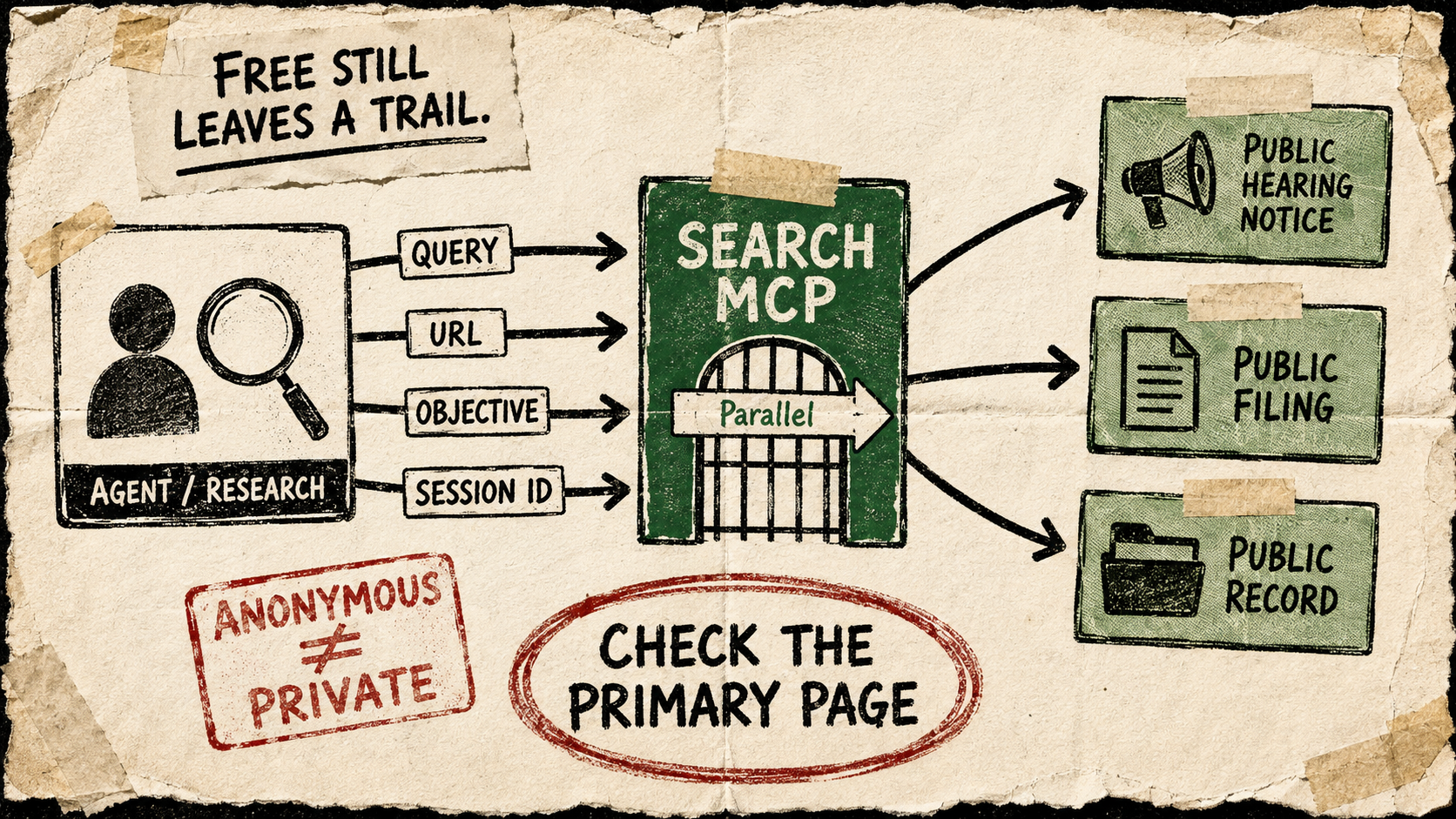
API discovery: Parallel’s public Search MCP documentation identifies https://search.parallel.ai/mcp as its anonymous, lower-rate endpoint. Microsoft Agent Framework’s new Python MCP example connects to that endpoint with MCPStreamableHTTPTool, then calls web_search and web_fetch directly. The sample needs neither a Parallel key nor a model-provider account for those direct calls.
The useful discovery is not “free web search.” It is a compact, inspectable research loop: create one UUID for a related set of searches and fetches; use search to identify public primary sources; then fetch the shortlist for a more useful reading task. The Framework sample preserves source URLs and excerpts in the returned tool content, which makes it practical to hand an agent a narrow public-record assignment instead of merely asking it to browse. This is documentation, not a Framework default: the integration PR adds the example without changing provider configuration or defaults.
Try it
Try a disposable local briefing on a proposed civic project. Ask the agent to search for the project’s public hearing notice, planning application, and the developer’s filing; then fetch only the official pages and return a three-link chronology with the date and source for each claim. A shared session ID keeps that mini-investigation coherent. It does not make search output authoritative: use the returned URLs to check the underlying primary records before publishing or acting.
Copy-paste agent instruction
Use Parallel Search MCP only for public, non-sensitive research. Create one new UUID session_id for this conversation and reuse it for related web_search and web_fetch calls. First propose two or three focused, diverse queries for the research question; search them with a clear objective; then fetch only the shortlisted public URLs. Return the original URLs, publication dates when visible, and a short claim-to-source map. Treat snippets as leads, not proof: verify consequential claims against the primary page. Do not send credentials, personal data, private URLs, customer records, or confidential objectives to this MCP.Test caveat
“Anonymous” is an access condition, not a privacy promise. Microsoft’s sample says that queries, requested URLs, objectives, and the session identifier are sent to Parallel. Parallel says the anonymous endpoint is lower-rate, uses server-managed fast mode, and uses session_id for free-tier rate limiting and log correlation. Its authenticated /mcp-oauth alternative requires a key or OAuth when attributable traffic is needed. This report did not run the sample or measure result quality, and the Framework change is documentation for a direct-call example—not a guarantee about every client, result, retention policy, or production integration.