Daily Edition Sources +4

A Child Agent Can't Promise Its Watcher to the Parent

Hermes now makes a child wait, kill, or formally hand over background work before it returns—ending one treacherous kind of progress report.

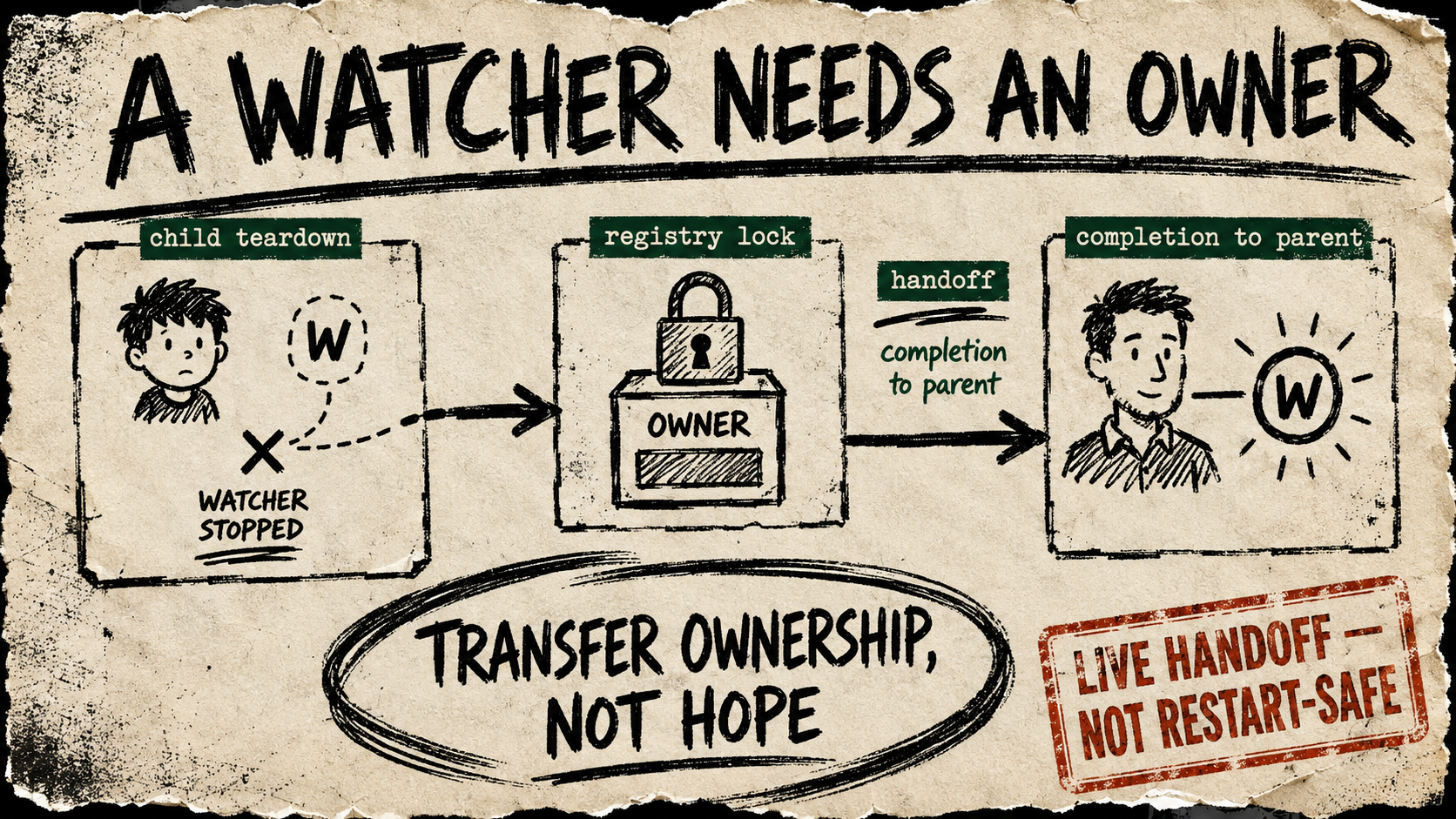
Photocopied marker diagram showing a child agent’s watcher stopped at teardown unless a handoff crosses a registry lock to the parent, with a live-handoff-not-restart-safe caveat.
Diagram PunkHermes makes the owner of a background result visible before the child leaves.
repo NousResearch/hermes-agent evidence
4 source signals 1 repo commit 3c0d90e
Evidence: commit 3c0d90e / September 8, 2026 / Daily Edition
Open Edition Evidence below

In a September 7 NousResearch/hermes-agent commit, a child must now wait, kill, or formally hand off background work before it returns. That matters when a parent hears “the CI watcher is running,” waits for a result, and never gets one because child teardown killed the watcher: a result needs an owner who can actually receive it.

The new handoff action lets a child transfer a running process it owns to its parent. Hermes changes the process’s owner and session under a registry lock, carries a one-sentence purpose with its completion, and lets the parent poll, stop, or receive the result. The transfer is deliberately narrow: it is only for a live child-owned process, rejects foreign or exited work, and caps each child at three handoffs.

“Running” is not a status if nobody will hear the finish

That boundary is the story. Hermes’ public delegation guide says that child-owned background processes are killed when the child ends unless the child waits, kills them, or hands them off. Sharing a terminal environment does not silently transfer ownership. The runtime now refuses to let a child’s final prose do that job by implication.

The focused handoff test makes the difference concrete. It hands one child-owned process to the parent and checks that its completion arrives with the purpose “CI watcher for PR 1.” A sibling process that was not handed off is recorded as orphaned before cleanup terminates it. The parent gets a receipt from the runtime, not a hopeful sentence from the child.

Handoff is not durability

The tempting headline would be that Hermes made child work survive. Its own source says otherwise. Handoff moves a live process to a parent; it does not checkpoint it, make it restart-safe, or guarantee a remote CI service will stay reachable. For a watcher, the documentation still prefers a simpler pattern: return the PR number and SHA, then let the parent start the watcher it intends to own. The change is included in Hermes’ v2026.9.7 patch rollup, but that is packaging evidence, not a report of adoption or reliability in the wild.

That restraint is the transferable rule. In any nested agent system, a “done” message should mean one of three things: the work finished, ownership was explicitly transferred, or the work was stopped and disclosed. The next useful signal is a test of what happens when the parent is interrupted—because a watcher only becomes trustworthy when its ownership remains visible at the next failure boundary.

Evidence Trail

Receipts below the story

The article above is the public narrative. This section keeps the source trail and limits on the same page.

Edition
DateSeptember 8, 2026
LaneDaily Edition
Confidence78%
Sources4
ReposNousResearch/hermes-agent

Primary Evidence

  • Hermes process-handoff implementation: commit 3c0d90e
    • Shows: the public implementation change that adds a child-only handoff action, moves a running process to the parent under the registry lock, records a purpose with the completion, and names work left for teardown.
  • Hermes delegation guide: background-process handoff guidance
    • Shows: the documented user-facing contract: child background work must be waited on, killed, or handed off; parent ownership is explicit rather than implied by a child’s final summary.
  • Hermes regression receipt: subagent process-handoff test
    • Shows: a public test of both sides of the rule—an explicitly handed-off completion reaches the parent, while an unhanded child process is reported as orphaned and then cleaned up.
  • Packaging receipt: Hermes v2026.9.7 tag
    • Shows: the patch-rollup tag ancestry containing the implementation, without claiming a feature-specific release announcement.

Evidence Limits

  • These public commit, documentation, test, and tag receipts do not prove production reliability, adoption, restart recovery, or behavior across every platform and CI provider. They demonstrate an intended live-process ownership rule.
  • Watch for release notes or regression evidence covering parent interruption, process restoration, and long-running external watchers. The most useful next question is whether a transferred process remains correctly owned when the parent itself is interrupted or resumed.
Letters & Corrections

Send a note to the desk

Corrections, missing context, or a follow-up lead.