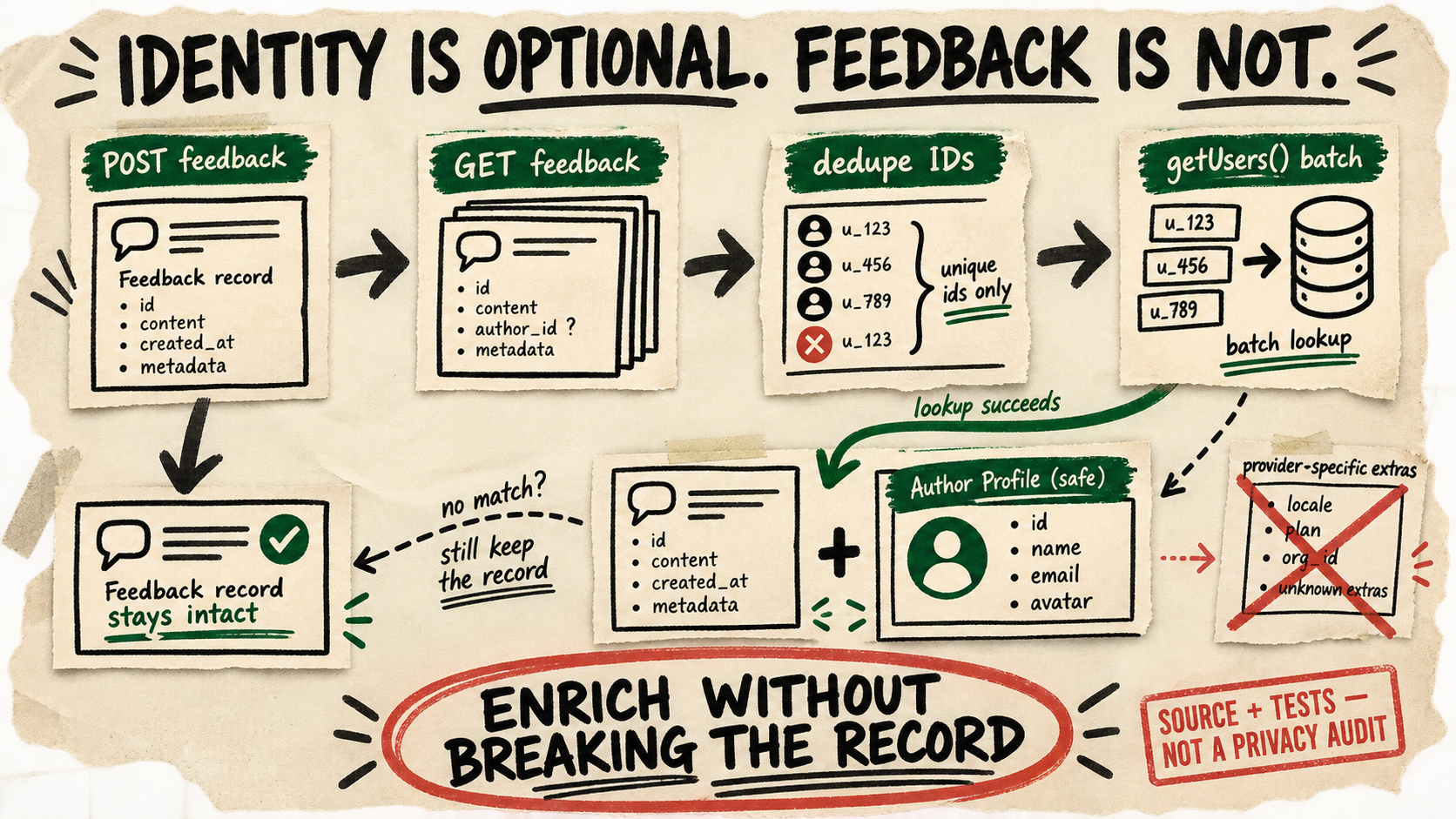
A feedback list becomes brittle the moment “show the author” means “the identity service must answer.” Mastra’s September 7 observability change takes the harder route. The public commit credits Mastra Code (openai/gpt-6-astra) as a co-author, then adds a feedback path that can use an authenticated identity when present without making identity a precondition for accepting or listing feedback.
The repo evidence
On write, an authenticated identity becomes the feedback author when available; without one, the source preserves an explicitly supplied ID or leaves the record anonymous. On read, the inspected author-enrichment helper treats the profile as a soft attachment. It chooses the active Studio or server directory, deduplicates IDs, asks for one batch when the provider supports it, and otherwise resolves each unique ID in parallel. Missing providers, missing users, and lookup failures leave the feedback record itself alone.
That is engineering rather than a cosmetic author field. The helper projects only a small shape—ID, name, email, and avatar URL—rather than passing provider-specific fields through. Its public test suite checks batch deduplication, per-ID failure, an absent provider, a separate Studio directory, and private-field stripping. The client’s SDK test adds the optional profile to the existing listFeedback() response with one request rather than a row-by-row fetch.
The transferable skill
Build enrichment as a left join. First preserve the primary record and its ordering, pagination, and anonymous case. Then add a safe, explicit projection only when lookup succeeds; deduplicate the keys before the directory call; and make failure mean “metadata unavailable,” not “the whole request failed.” That pattern applies to feedback, audit trails, issue lists, billing notes, and every agent console that wants to connect a durable event to a human without turning a secondary service into the event’s owner.
The limit
The co-author credit is public proof that a coding agent participated in this work, not a claim that it wrote every line or made every judgment. The commit and tests show intended repository behavior, not a released deployment, organization-scale performance, or a complete privacy outcome. In particular, an operator still has to decide whether an available email belongs in a given feedback view. The next useful signal is a release and a policy surface that make that display decision as explicit as the lookup’s failure behavior.