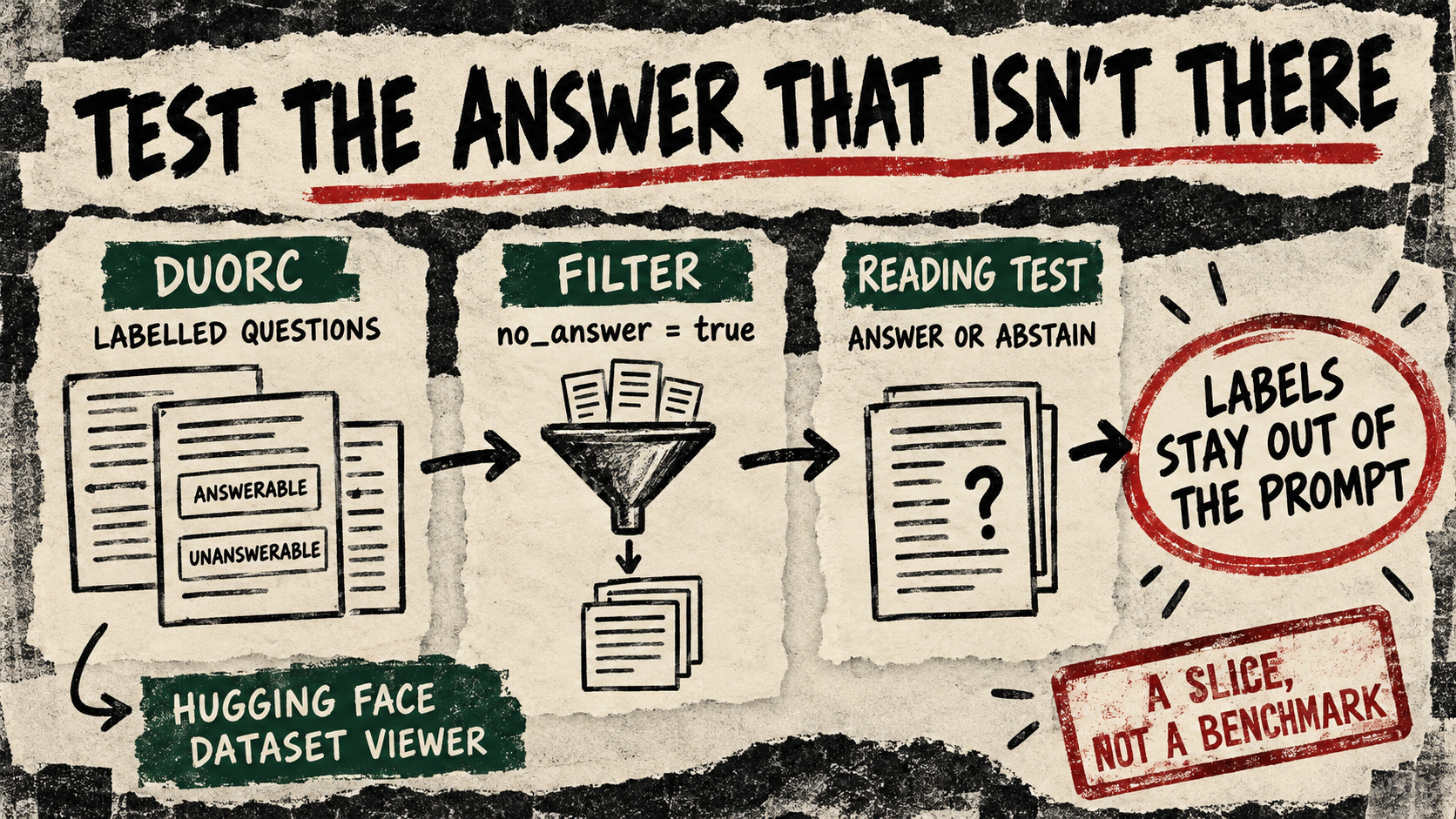
A reading assistant needs practice saying that a supplied passage does not contain the answer. Hugging Face’s Dataset Viewer filter API offers a small way to build that check: request rows whose existing dataset label says no answer is available, alongside answerable controls.
A useful example
IBM Research’s DuoRC includes movie plots, questions, answers and a no_answer field. For a local reading exercise, select a few rows from each label, give the model only the plot and question, then compare its answer or abstention with the held-back labels. Review disagreements manually. This is a small diagnostic, not a representative benchmark or proof that the model resists hallucination.
curl --get 'https://datasets-server.huggingface.co/filter' \
  --data-urlencode 'dataset=ibm-research/duorc' \
  --data-urlencode 'config=SelfRC' \
  --data-urlencode 'split=train' \
  --data-urlencode 'where="no_answer"=true' \
  --data-urlencode 'offset=0' \
  --data-urlencode 'length=3'
The endpoint returns row content and feature definitions. It requires a dataset with Parquet exports, and caps a requested page at 100 rows. Use the current dataset name: the older ibm/duorc name in the filter guide returned a rename error during our check.
Copyable agent instruction
Build a local reading-comprehension fixture using the Hugging Face
Dataset Viewer /filter endpoint. Use ibm-research/duorc, SelfRC,
train. Retrieve three rows where "no_answer"=true and three where
it is false, with length=3 and offset=0. Stop and report HTTP errors;
do not treat an error response as an empty dataset.
Check the returned labels and truncated_cells. Save retrieval time,
query parameters, response revision header if present, row indices
and question IDs. Keep answers and labels in a separate scoring file.
Create model inputs containing only plot and question, instructing
the model to answer from the passage or say there is no answer.
Do not call a model yet. Show me the fixture and dataset terms first.
Test caveat: retrieval, not a model score
On September 18, both corrected requests returned HTTP 200 without credentials. The three positive-filter rows had no_answer=true and empty answer lists; the three controls had false labels and nonempty answers. All six reported no truncated cells. We tested retrieval, not model performance or label correctness.
Access to other datasets may require authorization. Dataset terms still govern reuse, and a small first-page sample is neither random nor stable across dataset changes. Preserve provenance, inspect partial-result metadata and check the API definition when adapting the query. The useful outcome is an inspectable fixture you can challenge before spending money on an evaluation.