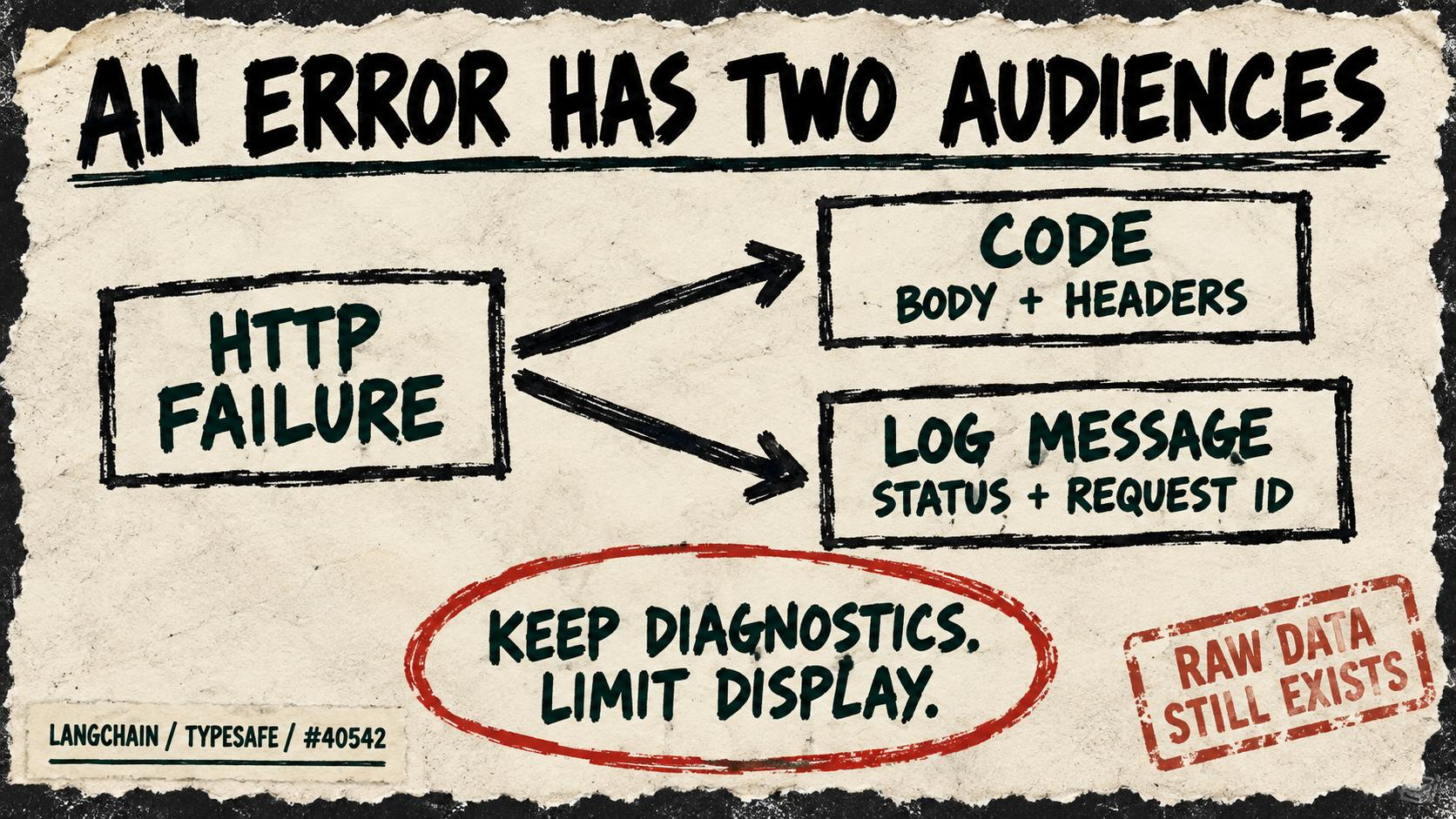
A classification request fails. The program needs enough detail to distinguish a bad credential from a busy service. The person reading its logs may need only the status and a request identifier. Putting both audiences through the same error dump can turn useful diagnostics into an unintended copy of the input data.
That is one of the less visible pieces of LangChain’s September 17 TypeSafe integration. Hunter Lovell’s contribution introduces a classifier for categorical, binary and ordered decisions. It also implements the HTTP contract directly instead of delegating it to TypeSafe’s SDK. In the public contribution description, Lovell discloses substantial assistance from Sol and says he personally reviewed the work.
That disclosure establishes coding-agent participation, not the authorship of each line. The engineering case rests on what the client and its tests actually do.
Two views of the same failure
In the response-handling module, an API exception retains the status, response body, headers and request context as structured attributes. Its normal string and representation methods omit the body and headers. The endpoint formatter removes URL credentials, query parameters and fragments while retaining the method, host and path.
That lets a program inspect provider details without making the full response the default human-facing message. The type hierarchy preserves another distinction: callers can catch the provider’s own exception or LangChain’s shared category. A 401 is an authentication failure; a 429 carries rate-limit meaning and a parsed retry delay. A server overload remains a different failure from an invalid request.
This is useful infrastructure, but it does not retry the call for you. The first integration leaves retry policy outside its scope. A caller still has to decide whether another attempt is appropriate and how long to wait.
The transferable skill: test both audiences
The error tests show a pattern worth copying. Construct a synthetic response with a private marker in its body and credentials in its request URL. Assert that application code can still inspect the structured body and request ID. Separately assert that the ordinary string and representation exclude the private body and URL secrets. Neither half of that test substitutes for the other.
Then test the decision the failure enables. The suite checks provider and framework exception categories, retry-delay parsing, malformed successful responses and preservation of exception attributes through serialization. A response with HTTP 200 can still fail schema validation; transport success is not a usable classification.
For your own integration, add one more test around the actual logger or tracing system. This implementation deliberately retains raw fields, including exception arguments. Its response-validation failure is raised from the underlying validation error. A collector that serializes attributes or captures chained exceptions may therefore see information absent from str(error). The source supports a narrower display contract, not a universal redaction claim.
We inspected the client, classifier, response models and tests; we did not run this package’s suite or call TypeSafe’s service. The work’s value is not a measured privacy guarantee. It is a concrete way to keep error handling useful while making the default display selective—and a reminder to test the next system that receives the exception.