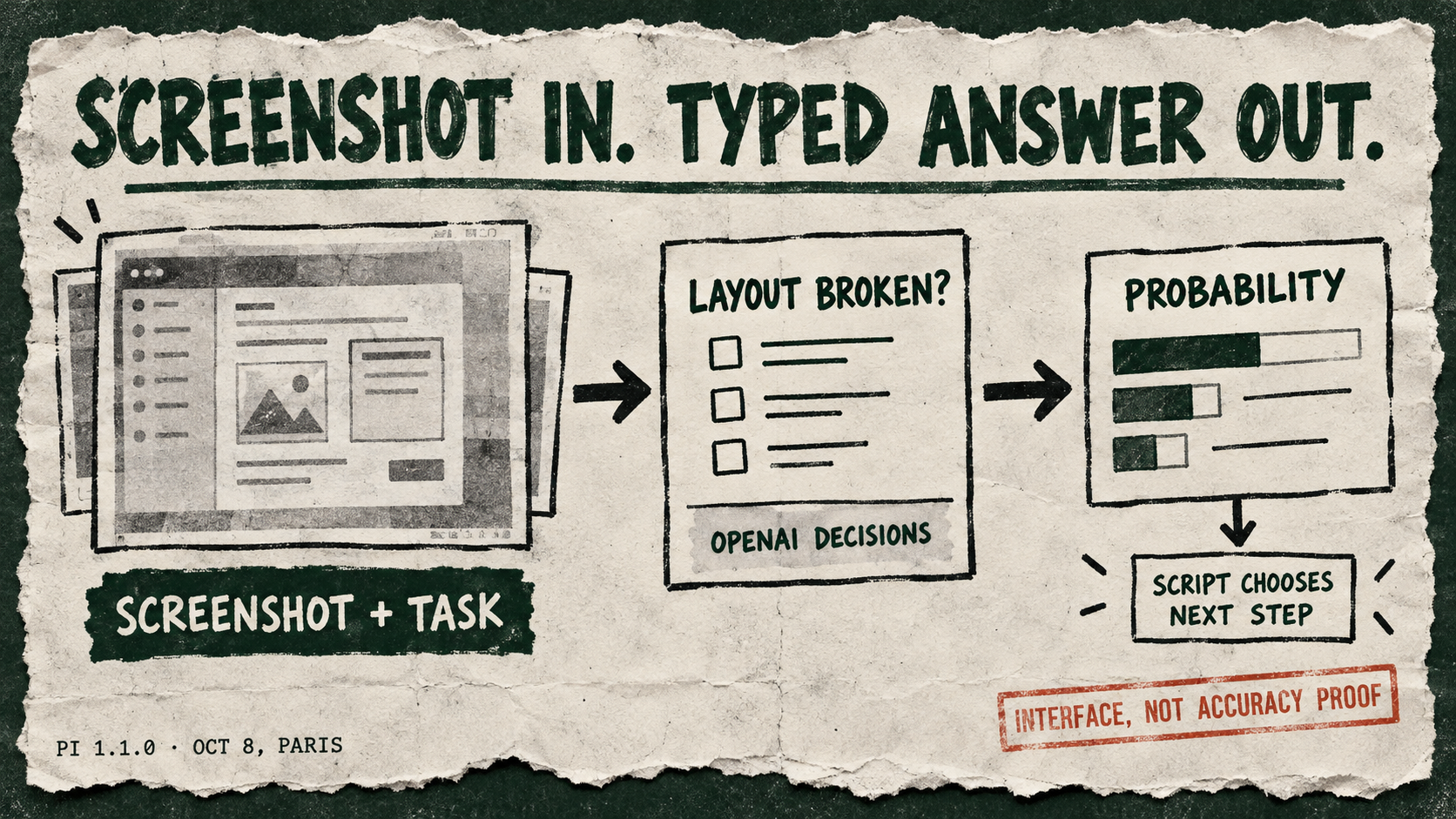
Pi, the open-source coding agent in earendil-works/pi, has released an interface for asking narrow questions about screenshots from inside its agent-written scripts. Its 1.1.0 release, published shortly after midnight October 8 in Paris, adds image input and OpenAI Decisions to the classifier machinery that those scripts can call.
The project's example makes the purpose concrete: read a screenshot of a redesigned settings page, attach the task description, and ask whether overlapping, cut-off or misaligned elements make the layout broken. The answer arrives as a probability for that Boolean question. A script can use it to select its next step without first extracting a verdict from a paragraph.
That opens a useful experiment for builders who already ask agents to inspect interfaces: give a recurring visual check its own question and result. The published example demonstrates how to make the request. It does not demonstrate that the model reliably catches layout defects.
A new input for an existing job
Pi introduced its typed classifier interface on September 23. The interface already accepted structured state and questions requesting choices, scores or Boolean judgments. Our September 29 reporting followed a related question: whether using a separate decision model actually improves the economics of a completed workflow.
The October 7 change adds something more specific than another model name. Classifier requests can now include images alongside that state, and a new adapter sends them to OpenAI's Decisions endpoint. A classifier that cannot accept images returns an error instead of silently discarding them.
In Pi's codemode, the main agent writes a JavaScript script that can call tools and classifier models. The script might obtain a screenshot, ask a question and return only the useful result to the main conversation. It remains responsible for interpreting that result. This change does not automatically install a visual reviewer, choose a confidence threshold or route difficult tasks to a stronger model.
The beta now has a released client path
OpenAI's October 6 changelog records the Decisions API's beta release, following its limited preview. OpenAI describes the service as a faster route to bounded answers. Its current guide lists GPT-6 Luna and predicate, choice and score questions, with text and image input. We have not measured the vendor's speed claim or made an authenticated request.
Pi's integration is available beyond a merged development change. We downloaded the published pi-ai 1.1.0 and coding-agent 1.1.0 packages, checked their hashes against registry metadata, and found the compiled adapter and script support. We did not install or execute those packages.
Access has a separate boundary. Pi's provider code hides classifier entries when the OpenAI credential is a ChatGPT sign-in token. This path requires an API key. Being signed into Pi with a ChatGPT account is therefore insufficient, and the existence of a catalog entry does not establish access for every account.
What a typed answer carries
The adapter puts the structured state into text and attaches images as inline data in the same user message. It translates Pi's Boolean questions into OpenAI predicates, preserving the caller's descriptions of what true and false mean in the instructions.
The returned shape depends on the question. A choice includes a selected label, option probabilities and confidence. A score returns a number and confidence. A Boolean returns a probability. These are useful values for code, but their presence does not establish that confidence matches real-world correctness.
A refusal also needs its own branch. If one requested answer is refused or malformed, this adapter clears the answer map and returns an error while retaining any reported usage. The script must inspect the result before acting; the adapter does not substitute another model automatically.
The upstream tests exercise image serialization, answer matching, refusals and error handling with mocked responses. We inspected them but did not run them. They establish the intended client contract, not an evaluation of visual judgment or an audit of OpenAI's closed model.
The next useful comparison is a small set of fixed screenshots with known defects and identical criteria, run through both the classifier and chat paths. Count missed defects, false alarms, latency and the work needed to handle uncertain answers. Pi has supplied the interface that makes such a comparison practical. Whether a separate visual judgment earns a place in the workflow depends on what happens after the number comes back.