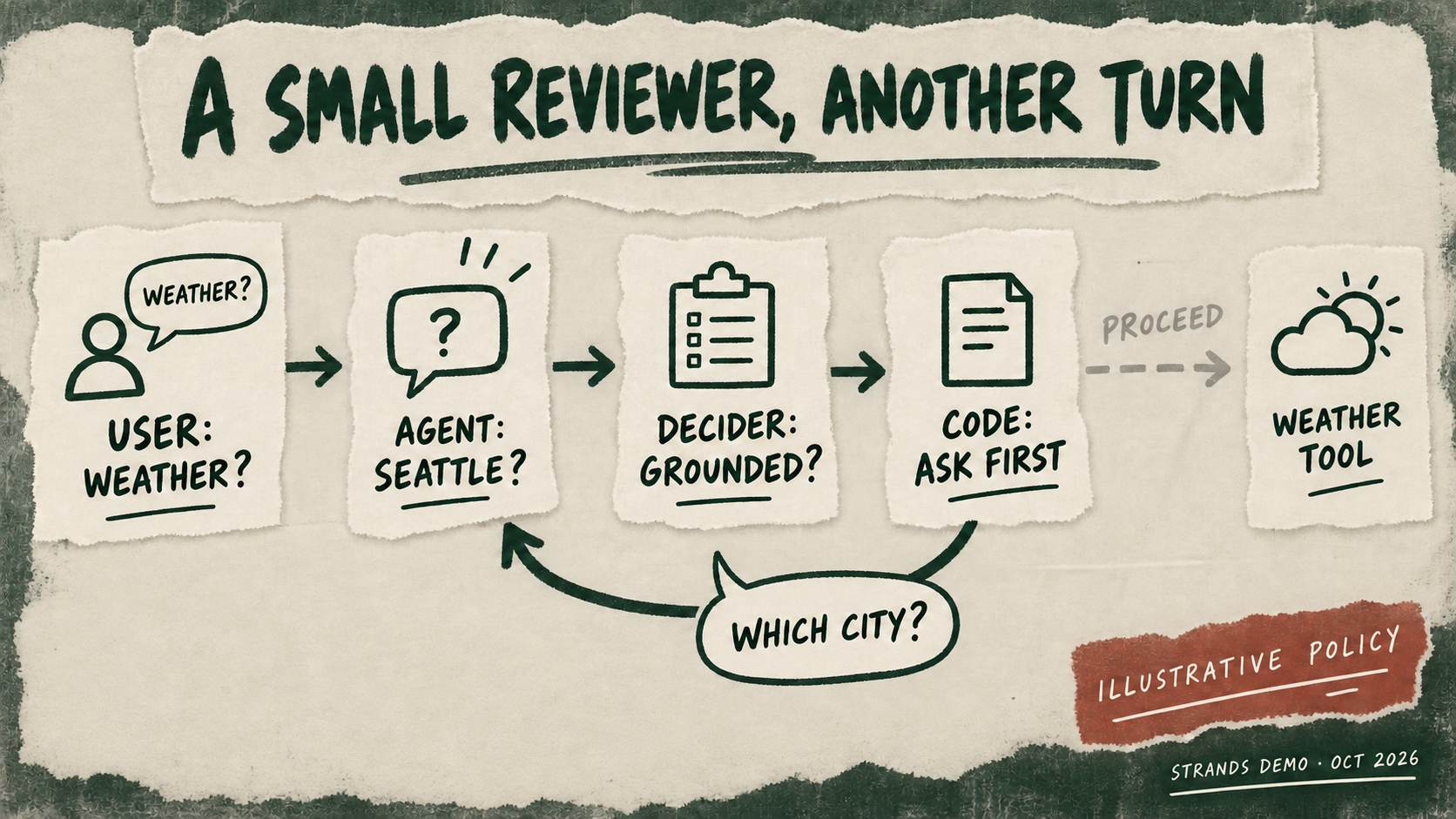
The weather assistant has a problem before it calls the weather tool: nobody has told it a city. In Strands' October 1 demonstration, a small reviewer can send it back to ask. The reviewer does not write a better forecast. It judges whether the proposed action is grounded in the conversation; a few lines of Python decide what to do with that judgment.
This is a useful place to look at the promise behind “System 1” decision models and “System 2” reasoning models. The interesting question is where each does work. A fast model can review a larger agent's proposed action, select among browser controls or classify a document before any rewriting begins. The surrounding software constructs those jobs and decides what warrants another turn.
The distinction extends our September 22 examination of decision probabilities and September 29 comparison of their costs. Those reports asked what a returned number means and what it costs to obtain. The integrations now make another question inspectable: who turns that number into an action?
The reviewer comes after the proposal
The Strands example deliberately tells its agent to assume Seattle when the user omits a location. Before the resulting tool call executes, Decider receives the conversation and proposed arguments. It answers two narrow questions: whether the arguments are grounded in what the user supplied, and whether the call is premature.
Python compares those outputs with an illustrative threshold of 0.45. If the arguments look ungrounded or the call premature, it returns Guide, giving the generative agent another turn with corrective feedback. Otherwise it returns Proceed. The small model supplies judgments; the program owns both the threshold and the consequence.
The example uses fake weather and an intentionally bad prompt. It is an experimental demonstration, not a measured reduction in naturally occurring errors. Its agent uses Claude Haiku 4.5 through Bedrock, without an explicit reasoning configuration. Calling this a demonstrated partnership between a System-1 model and a System-2 reasoner would overstate the source.
Its placement nevertheless matters. The generative agent has already proposed an action. Review happens at the execution boundary, where feedback can change the next turn. That offers a reusable design choice for builders: inspect a concrete proposal when its arguments are available, rather than asking a router to predict everything about the task at the start.
The review client talks to a separate local endpoint. That can keep this review computation local; it does not make the Bedrock-backed agent's entire conversation local. The deployment boundary belongs in the design alongside the decision boundary.
“Decision model” describes a job, not a size
Strands' architecture starts with a pretrained language-model backbone. It removes the text-generating head and uses a pointer head to score the options supplied in the request. The same mechanism can answer a yes/no question, choose a label or assign a score on an ordered rubric. It does not generate a deliberation transcript.
Fresh source broadens the hardware and model choices. An October 8 change adds support for several Gemma 4 backbones, including larger variants. That is implementation support, not evidence that each variant improves a complete agent task. It does show why “decision” should not be treated as a synonym for “tiny.”
System 1 and System 2 are useful metaphors for bounded judgment and more extensive deliberation. They are not two settled species of software. A generative model can also return a classification; a reasoning-capable model may help design the workflow without answering every runtime decision.
The browser's escape hatch earns its place
Browserbase's September 21 account offers a different arrangement: use Jev to select a browser action and target, then fall back to an LLM when needed. Here the fast path comes before the general-purpose one.
The corresponding Stagehand pull request remains open and experimental as of October 8. Its author reports median action latency falling from 1.97 seconds to 0.46 seconds, with 39 of 40 tasks completed by the baseline and 118 of 120 across three hybrid trials. Disabling the LLM entirely reduced completion to 27 of 40. The fallback is part of the reported capability.
The same report says thresholds were tuned on those evaluation suites, and some tasks and reporting scripts are omitted. These are author-run, in-sample results, not our reproduction or a shipped-product guarantee. They justify investigating the combination, not assigning its speedup to a decision model alone.
The implementation also divides work more finely than “easy versus hard.” Code parses supported arguments and constructs candidate elements. A separate, small LLM request can extract an unquoted argument, constrained to text from the instruction. After an action, deterministic checks can read back a field's value. Selection, argument preparation and verification have different owners.
For a builder, that is the useful lesson: improve the state and available actions before assuming a more powerful model is the only way to improve the decision. The selector can only choose among the possibilities the application presents.
Sometimes escalation means a person
LangChain's September 25 document-review example separates classification, rewriting and human review. A decision model judges a page; an LLM handles redaction; potentially privileged material goes to a person. Escalation reflects the kind and consequence of the work, not simply model size.
The pinned implementation makes that policy visible. Suspected privilege goes to human review first. Low responsiveness is withheld. Production requires sufficiently high responsiveness and confidence, with a redaction step when personal information is detected. Its six-page corpus is synthetic, so this is an architecture example, not evidence of successful legal deployment.
The same package includes a chat-model adapter that satisfies the classifier contract. That is strong counterevidence to a rigid two-model story: the workflow can preserve its division of labor while changing the machinery behind one step. Its notes also report that changing the confidence formula changed routing agreement. Identical-looking fields do not make thresholds interchangeable.
A different relationship appears in Andrew Boyd's Pokémon experiment. The project credits Jev with gameplay and Opus 5 with monitoring logs and building the surrounding harness in real time. The site reports completion on September 23. That is an author account, not an independently replayed result, but it illustrates another role for the more capable model: improving the player's representation of the problem during the run. It should not be confused with a documented fallback call for every difficult move.
The next test belongs to the whole workflow
Conditional model use predates these names. RouteLLM's July 2024 report studied choosing between stronger and weaker models using preference data. It also found that routing learned on one distribution could perform poorly on another without task-relevant training data. Today's inspectable examples expand where bounded judgments can sit; they do not establish that conditional computation has just been invented.
There is fresh progress toward testing the choice. Laya's October 7 training change distinguishes evaluation inputs that overlap training or calibration from a separate held-out set. Its training code saves fitted abstention thresholds as metadata. Applications must still decide how to apply them at runtime. Better measurement machinery is a capability gain; it is not yet the missing comparison of completed workflows.
That comparison should hold the accepted task quality fixed and count preparation, classifier calls, fallback, retries, tools and human handling. It should also include a simple rule or task-specific classifier where one could do the job. A faster intermediate answer is valuable when the completed work retains the quality its reader or operator needs.
No paid inference or live integration experiment was performed for this article. We inspected implementation, test definitions and dated author reports. The concrete opportunity is to give each kind of judgment a deliberate place: proposing an action, reviewing it, selecting an option, rewriting content or asking a person. The model can supply the number. The workflow designer decides what that number is allowed to change.