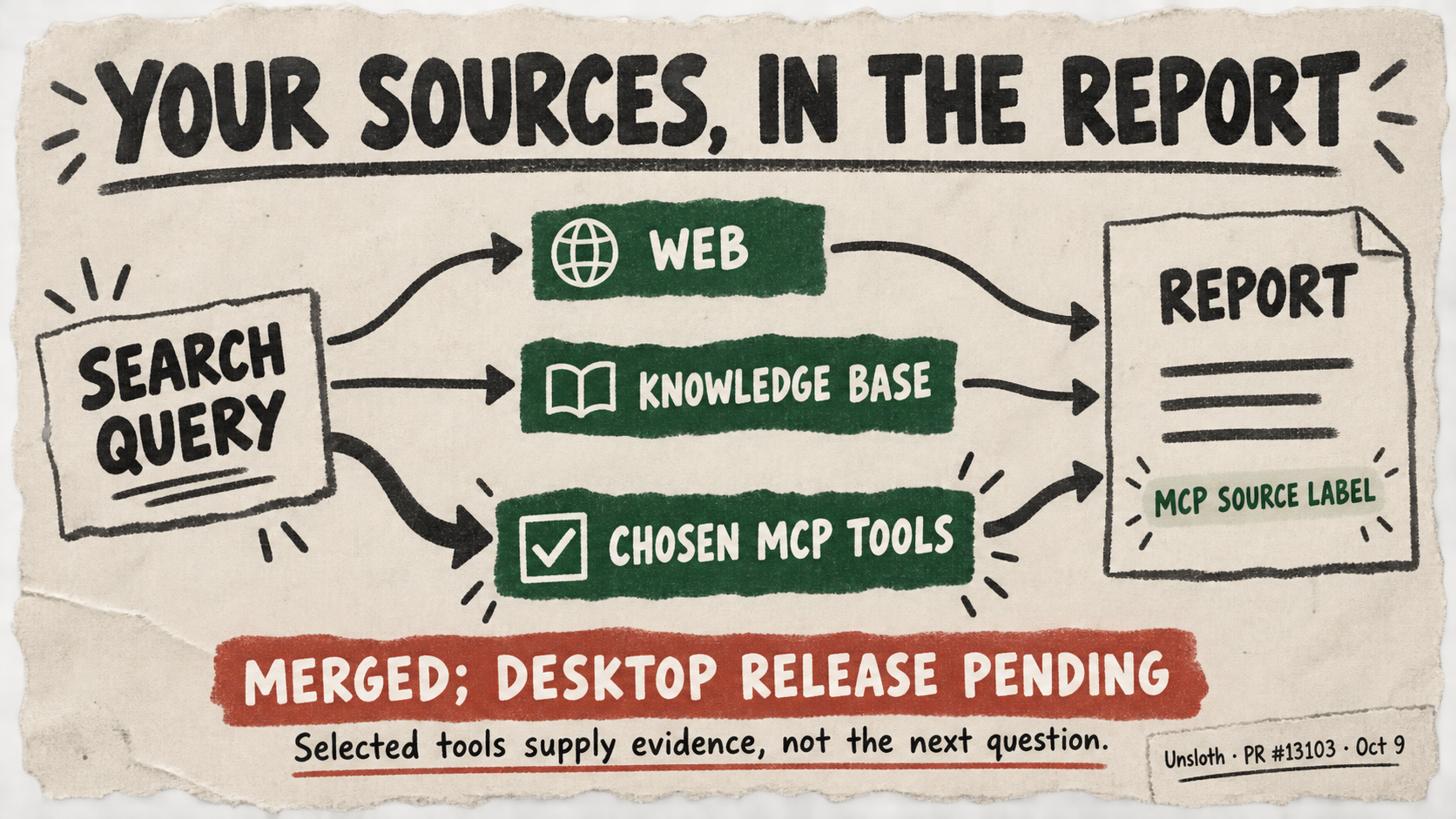
Unsloth Studio has added a missing connection between its research reports and the data sources a user already has. An October 9 merge in unslothai/unsloth lets users select MCP search tools for Deep Research. Those tools can contribute material to the final report, with citations identifying which server and tool supplied it.
For someone whose useful information lives in team notes or a specialist database, this creates another route into a research answer. A compatible search tool can expose that information without first copying the corpus into Studio’s knowledge base. MCP, the Model Context Protocol, provides the connection; this change makes the research workflow actually use it.
The distinction matters for availability, too. This is merged development code. The latest inspected packaged Desktop beta, v0.1.905-beta, published October 8, does not contain the change. An existing desktop installation should not be assumed to offer it yet.
A connected source that research never called
Studio’s July 27 Deep Research implementation already combined web searching with knowledge-base material. But connecting an MCP server elsewhere in the application did not add it to that workflow. An October 2 feature request asked for custom servers and a way to choose which ones a research session could use.
The patch author’s public reproduction makes the gap concrete. Using the same small Qwen model and a synthetic team-notes server, the author asked for a fictitious project’s codename and approver. The old version searched public sources, never called the notes server and failed to recover the planted answer. The patched version queried the selected notes tool and incorporated the fixture’s answer. Selecting nothing produced no MCP calls.
That is an upstream-reported experiment, not our live test or a benchmark of research quality. Its useful lesson is about access: a model can spend many steps searching and still miss information held by a connected service if the workflow never asks that service.
One query, several chosen destinations
The new setup offers eligible tools from enabled servers, with none selected by default. Its discovery code accepts a narrow shape: a tool with exactly one required string argument, subject to existing name and argument safety checks. A search endpoint can fit; an arbitrary operation needing several required fields will not. Those checks classify tools—they do not independently certify what a remote server will do.
During each search step, the research worker sends the same sanitized search query to the selected eligible tools as well as its existing search path. The user chooses the destinations. The model does not select a different MCP tool and invent arguments for each step.
There is a consequential division inside that worker. Returned MCP material goes into the evidence used to write the report, but not the prompts that decide the next search. A regression test explicitly checks both sides: a fact supplied by the notes tool reaches the writing prompt and stays out of the decision prompts.
So a report can now draw on an internal answer without the researcher following that answer into a new line of inquiry. For a bounded question whose answer is already in the selected corpus, that is useful. For an investigation that must discover an unfamiliar project name in one private source and then search another for it, this patch does not establish that chain.
The citation names the supplier
The citation machinery gives MCP results their own labels, distinct from uploaded documents. The worker saves bounded excerpts, and the tests cover making saved tool evidence available when a run resumes. This makes the source trail more useful than an unlabelled passage pasted into the final answer.
The trail identifies a server and tool. If that tool returns a summary of several records, the label alone does not identify which original record supports each sentence. A reader still needs the underlying evidence to assess the claim.
We inspected the merged implementation and its parent, release ancestry and upstream test definitions. One isolated frontend citation test passed locally; two settings-related test files could not run because a dependency was missing. We did not execute a complete model-and-MCP research session. Nor does a local Studio installation make this a local-only workflow: web search remains involved, and selected tools or the configured inference provider may be remote.
The gain is specific and practical: people can decide which existing search sources contribute to a research report. The next useful demonstration is a containing release and a reproducible task with known answers in a real source, where the report preserves enough detail to check its citations. After that comes the harder question: can a fact discovered there change what the researcher asks next?