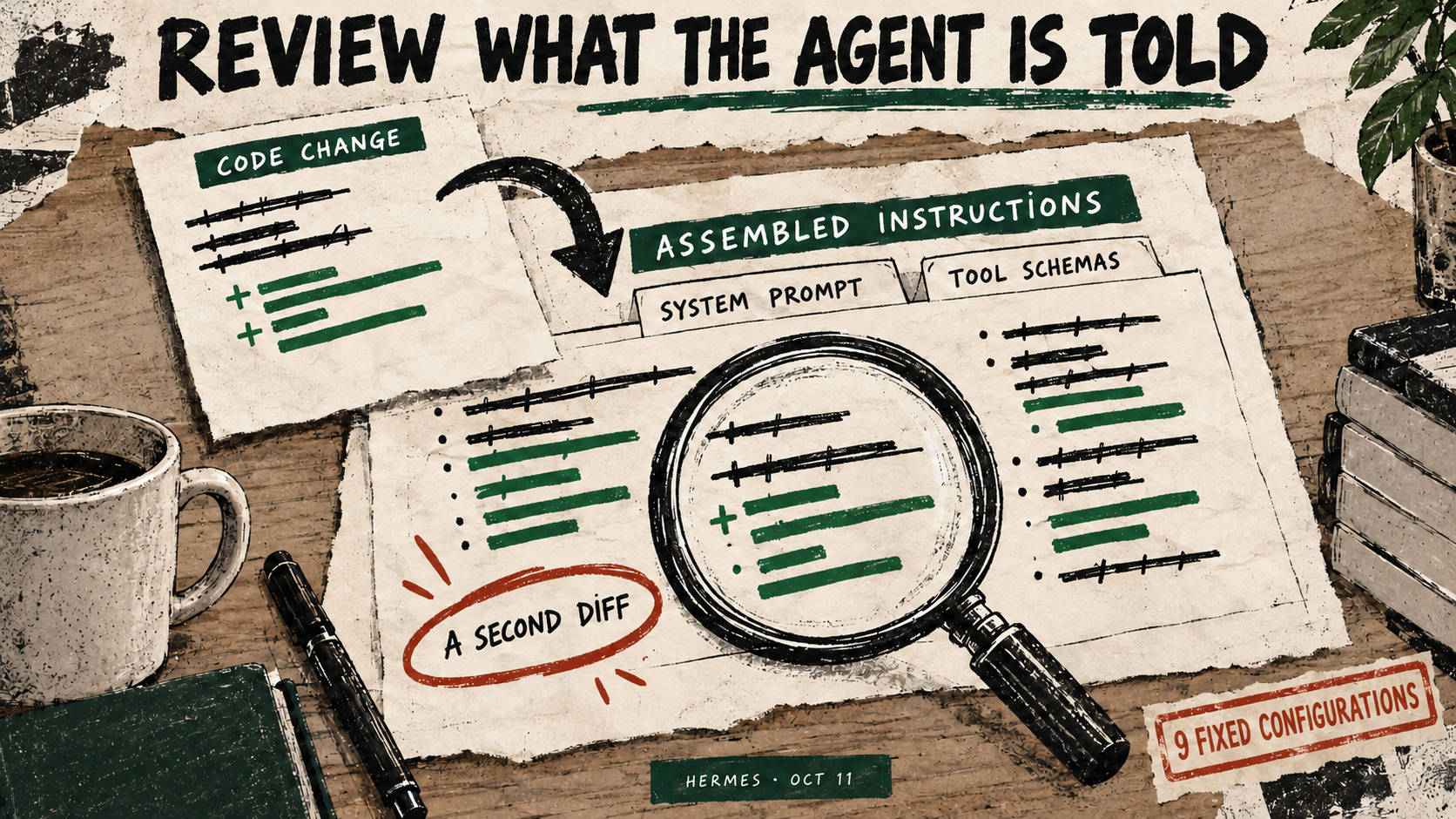
Hermes has added a second object to code review: the instructions its software assembles for a model. An October 11 change in NousResearch/hermes-agent saves rendered system prompts and tool definitions in the repository, then checks that those snapshots stay aligned with the code that produces them.
The benefit is concrete. A reviewer can read a Python change and still have to reconstruct what the agent will be told after configuration, model-specific guidance and tool descriptions have been combined. Hermes now supplies a repeatable version of that assembled result. It gives maintainers another way to see whether a seemingly modest edit changes the instructions they intend to ship.
An account name becomes an instruction
A later snapshot update on October 11 shows the mechanism doing useful work. Hermes’s connection-management tool gained named accounts and a rename operation. The saved definition exposes both the new input fields and the accompanying prose: when adding a second account, derive a short name from the user’s words and ask if the choice is uncertain.
That is more informative than a feature label saying “multiple accounts.” The interface now tells the model how to distinguish accounts and when to involve the person. The same artifact lets a reviewer examine whether the parameters and the instructions describe the same operation.
This update demonstrates the review object, not a successful account-selection task. It does not show that a model chose the right account or that a reviewer prevented a mistake. Its immediate value is making the intended contract easier to inspect.
Render the consequence, then compare it
The renderer uses Hermes’s production prompt-assembly code and the agent’s own tool definitions. It covers nine selected configurations: the command-line interface with four model families, a coding workspace, the desktop application, Telegram, Discord and scheduled jobs.
The variants matter. In the saved fixtures, the GPT-family patch tool includes a multi-file patch mode that the common tool definition does not. A single generic prompt file would hide that distinction.
To make comparisons useful, the renderer holds the environment steady. It starts with a fresh home directory, fixes the clock and other host-dependent inputs, blocks network access, and treats registered tools as available so missing credentials do not silently remove their schemas. These are controlled development examples, rather than recordings of someone’s conversation.
The staleness test renders again and compares the resulting files with the committed snapshots. When the assembled output changes, the contributor must update the snapshot too. A separate review-summary job reports affected configurations, prompt differences and tool-schema changes. Its token figures are rough character-based estimates, not a measurement of billed usage.
A baseline that people must still judge
There is a human review requirement as well. The initial commit described two core-team approvals; a same-day correction changed that to one. The public ruleset inspected on October 12 is active and requires one designated-team approval for changes under the snapshot directory. The summary itself is advisory. Detecting stale files and deciding whether new instructions are acceptable remain separate jobs.
Hermes already exposed and documented prompt assembly before this change. The new contribution is a maintained comparison of its output. Familiar snapshot testing becomes particularly useful here because the generated artifact contains instructions that can shape an agent’s choices.
The baseline is deliberately narrower than a live session. Its fixed model identifiers exercise selected branches; local project instructions and a user’s custom identity are excluded. Personal memory, installed skills, overrides and later conversation additions can also change what a real agent receives. This review cannot stand in for inspecting a deployment’s actual inputs or testing its behavior.
We inspected the implementation, fixtures, earlier documentation and public review rule. The upstream’s isolated summary test passed locally: it detected a changed prompt heading and tool description, and returned no change for identical snapshots. We did not run the full renderer or a model. This is merged development-workflow code; the latest inspected stable release, v0.21.6 from October 8, predates it.
For maintainers, the gain is a more answerable review question: what instruction change does this code produce? The next revealing receipt would be a public review where that second diff prompts a correction, followed by a task test showing the intended effect. Hermes has made the instruction change easier to locate. People can now argue about the text the machinery actually assembles.