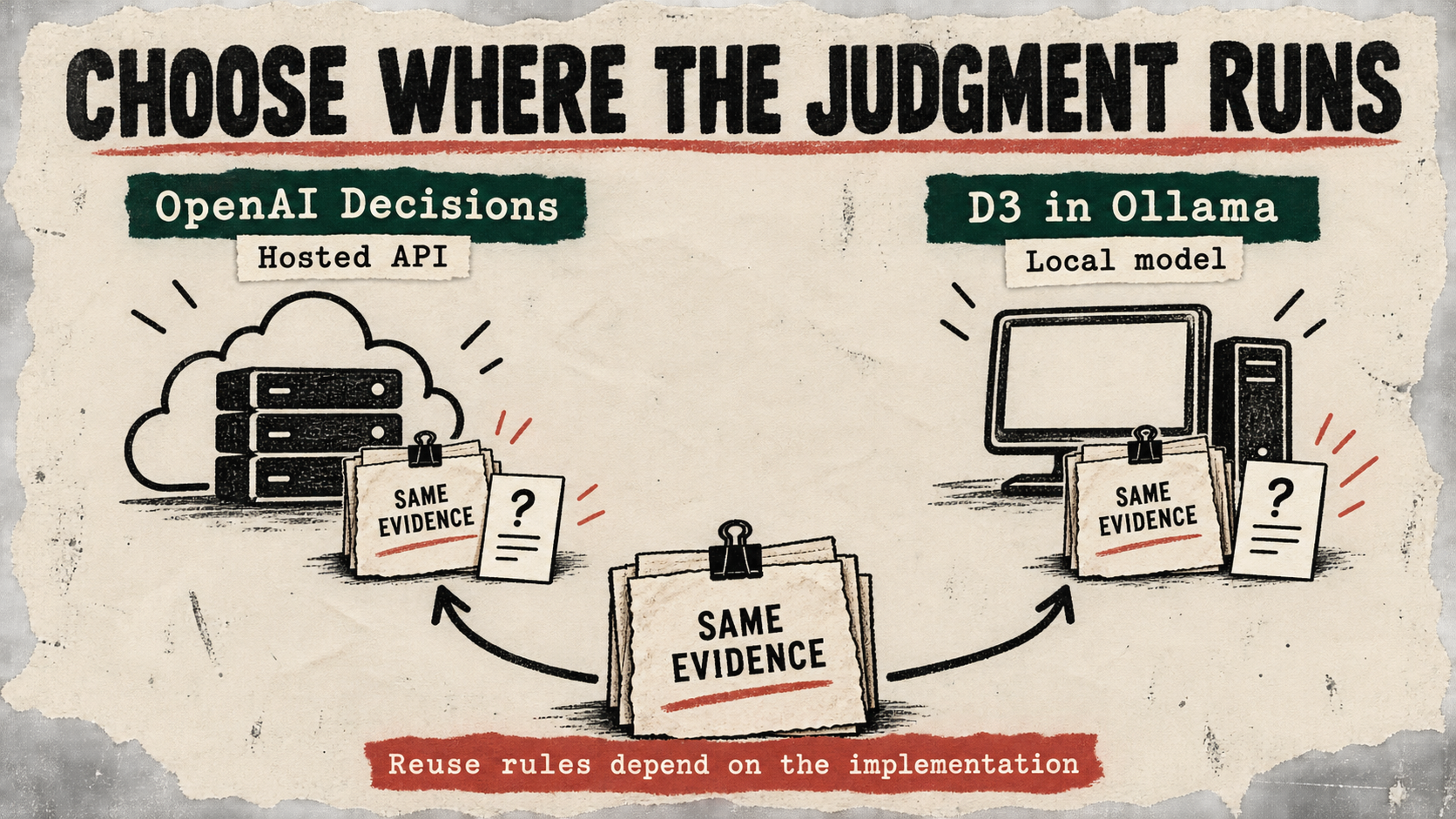
A decision model sits between an application's evidence and its next action. Given a support request, it can choose a department or score urgency; the application uses that answer to route the case. The ollama/ollama project has published support for D3, a family of downloadable models for this work, as OpenAI announces general availability of its hosted Decisions API on October 22.
For a team repeatedly judging the same document, this is a useful deployment choice. It is also a reason to look below the shared vocabulary. OpenAI documents reuse of shared input across requests. The new Ollama implementation inspected here recomputes a complete prompt for each question. That difference belongs to these implementations; it is not a rule separating cloud from local AI.
Keep the dossier.
Change the question.
Both routes can classify the same evidence. Where that evidence runs, and which computation can be reused, are separate choices.
Illustrative dossier: a damaged delivery, a receipt and a request for a replacement. The full reference material is abbreviated here. No model is called.
Evidence runs in the hosted service
OpenAI Decisions
The reference dossier
Which team should handle this?
Billing · returns · technical
For another question, an unchanged shared-input prefix of at least 1,024 tokens can be reused on a matching cache hit. The question and its instructions are outside that prefix.
Answer shape: a choice and probabilities. No answer is predicted here.
Read the shared-input cache contract. Reuse is conditional; each request still supplies its input.
Evidence runs on your machine
Ollama’s D3 MLX path
The same reference dossier
Which team should handle this?
Billing · returns · technical
For each question, this implementation builds state, question and options into a full prompt and runs a separate forward pass. It reports zero cached tokens.
Answer shape: a choice and probabilities. No answer is predicted here.
Inspect Ollama’s scorer. This is one runtime: the publisher’s engine separately caches image features.
The comparison describes request handling, not relative speed, accuracy or cost. A local model and a hosted service still need evaluation on the work you intend to give them.
A local package, with a concrete working size
D3 comes from vLLM Semantic Router, which publishes Apache-2.0 weights. Ollama's library offers 2B, 4B, 9B and 27B versions; the plain d3 name selects 4B. It requires Ollama 0.40.9 or later. This puts another decision-model family behind a familiar local installation and serving interface.
Read the package details before planning a workload. Although the listing cards show a 256K architectural context window, the published packages use 4,096 tokens. They accept text, structured state and still images; the publisher's broader video capability is not included in this Ollama offering. Its memory table describes particular Apple Silicon packages, while its displayed quality scores come from the original checkpoints. Neither is a measurement of your task on your machine.
Local decisions already existed: our September 29 reporting examined a local Laya path, and our October 8 article covered Decisions beta through Pi. D3 expands the obtainable choices. It does not establish the category or demonstrate that users are switching.
One document can carry several questions
Since its October 6 beta, OpenAI has added shared-input caching, native JSON and question-specific images, and doubled the question limit to 400. Its cache contract lets repeated requests reuse an identical shared prefix of at least 1,024 tokens. The changing questions sit outside that prefix. A cache hit can preserve earlier processing; the returned usage fields say whether reuse occurred.
That distinction matters for a stable reference document with changing questions. Grouping independent questions in one request and reusing a prefix across requests are separate capabilities. An answer that depends on another answer needs a later request. OpenAI's advertised improvement of up to tenfold speed is a comparison with GPT-6 Luna through its Responses API—not a D3 benchmark.
Why this D3 path reads the question with the evidence
The October 22 Ollama change exposes a different mechanism. In its MLX implementation, used for Apple Silicon acceleration, the scorer assembles the state, question and answer options into a complete prompt for each question. It runs that prompt through the model and reads scores for the supplied options.
The reason is visible in the model implementation. Its full-attention layers read in both directions within the prompt. Changing the later question or options can change how earlier evidence is represented. Reusing a causal model's saved prefix states would therefore produce the wrong intermediate computation. This scorer supplies no such cache and reports zero cached tokens.
That is not a verdict against local reuse. The D3 publisher describes another engine that caches image features. A model can recompute its question-conditioned text while another part of a serving system reuses image processing. Deployment location and reuse strategy belong on separate lines of the evaluation.
Choose with a completed task
We inspected the released interfaces, containing source and test definitions. We did not run D3 or make authenticated Decisions calls. OpenAI's closed model internals are not auditable from its API guide; Ollama's code and constructed-model tests do not establish judgment quality. The Ollama release page and current tag also disagree on their October 22 hours, so they establish present published support without settling the first binary's contents.
A useful next trial keeps the document and acceptance criteria fixed, asks a series of independent questions, then changes the document. Record correct and incorrect judgments, actual cache reads, memory, elapsed time and any human review needed to finish the job. The new choice is tangible: run an obtainable D3 package locally or evaluate the expanded hosted contract. Which arrangement earns its place depends on the completed work, including how often the evidence stays the same.