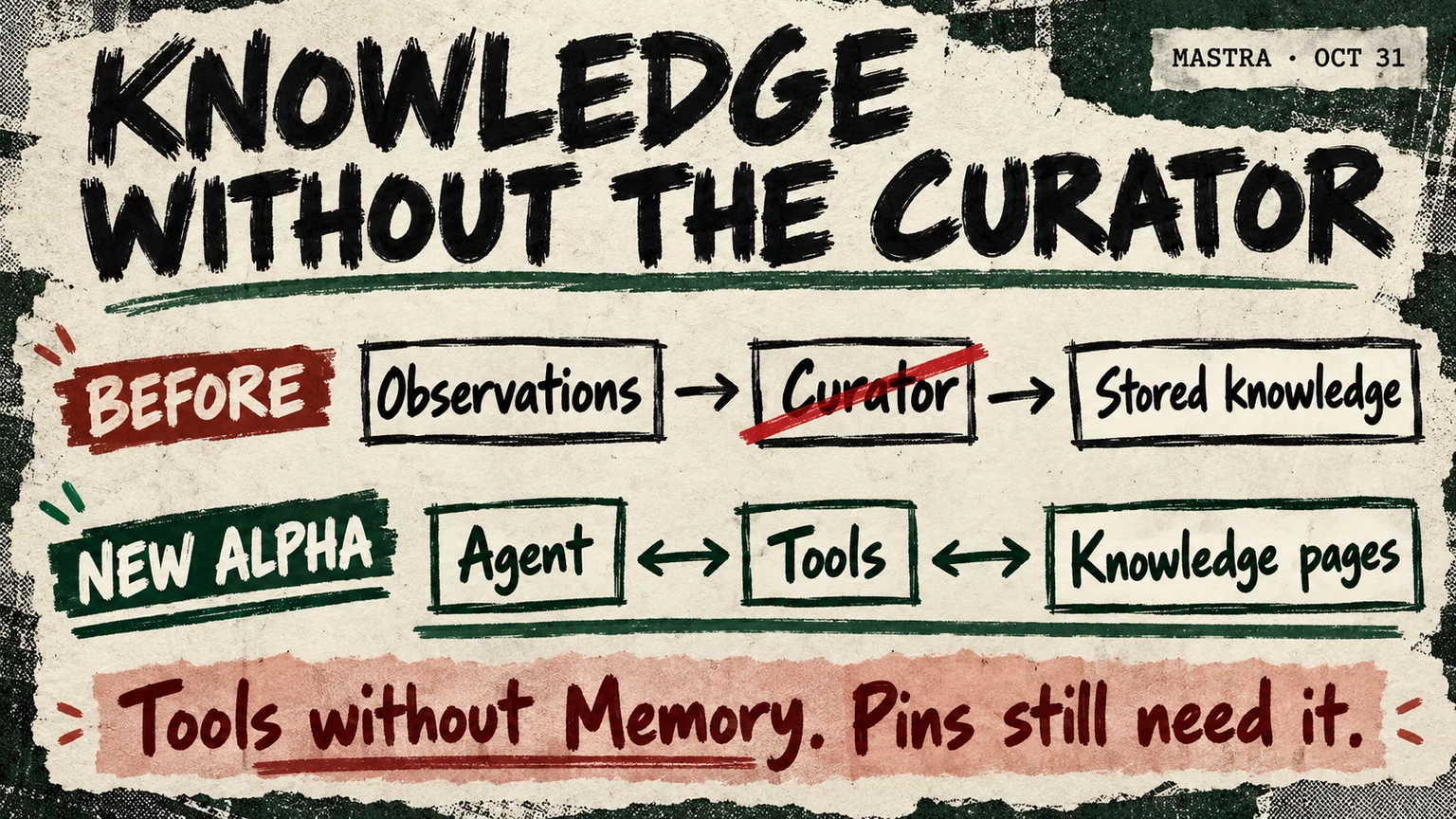
Mastra, a framework for building AI agents, has separated its shared knowledge store from the background curator bundled with its conversational Memory system. An October 31 commit merged in mastra-ai/mastra removes the experimental Subconscious component and attaches Knowledge directly to an agent, with tools for reading and writing pages.
This changes software around the model, not the model’s weights. Knowledge holds information that can outlast a conversation; Memory manages conversational context. The new Knowledge tools can operate without Memory. Automatically placing pinned pages into the conversation still requires it.
The redesign is merged alpha code. The latest @mastra/core package inspected on November 1, version 1.81.0, still contains the earlier node-based Knowledge implementation. It does not contain this page-based redesign.
An arrangement changes · October 31
The store no longer comes with this curator
Earlier experimental path
Committed observations fed a background curator which wrote stored knowledge.
The separate curator is removed. This highlights its writing path; it is not a map of every earlier tool.
New Knowledge alpha
The agent uses Knowledge tools to read and write pages and notes.
The host enables tools and declares access. The agent can still decide to write; no human editor is required by this design.
One dependency remains: page tools work without Memory; delivering pinned pages into conversational context still needs Memory.
Schematic comparison of the earlier curator and new attachment tests. No task execution or data migration is depicted.
Keeping knowledge is no longer tied to the bundled curator
The earlier Subconscious arrangement used a separate agent to identify durable facts from observations and organize them into Knowledge. This was active development: an October 19 change gave the curator its own thread. Immediately before the new merge, the curator hook waited for observations to be committed, then dispatched its work without making the parent observation wait for it.
The October 31 change removes that bundled background component. Knowledge becomes its own agent attachment, with its own instructions and configurable tools. These include searching, reading, editing pages and adding short notes. Tools existed within the earlier arrangement; the gain is an independently configured component, rebuilt around pages rather than nodes and records.
For a builder, that is a useful separation. An agent can consult a shared project runbook or record a durable fact without adopting this particular conversation-observation curator. The new instructions still ask the agent to search, cite what it uses and add lasting facts. Removing the separate curator does not make knowledge manual or prevent an agent from writing on its own.
A saved page and a page in context are different things
The configuration starts with tools off. The host can enable reading and writing, choose read-only tools, and separately enable pinned context. It also declares access scopes—for example, an organization or team—and supplies the identities held by the run. The model chooses operations within that arrangement; it does not declare its own membership.
A pinned page is meant to be brought into the conversation without a fresh search. That delivery still uses Memory. The distinction is unusually clear in the attachment tests: a scripted agent without Memory creates a page, adds a note and searches it. Another test lets a no-Memory agent call the pin tool successfully, but checks that no pinned text is delivered and a warning is logged.
“The fact was saved” therefore answers a different question from “the agent will see it next turn.” Builders can choose on-demand retrieval without the conversation layer, or add that layer for recurring pinned material. Neither choice guarantees that a model will record the right fact or use it correctly.
The alpha also changes what survives an upgrade
This is more than moving an import. The storage changeset says the new adapters drop the older experimental Knowledge tables and their rows at startup, then create the new page store. It explicitly preserves Memory and other storage domains. Existing experimental Knowledge data is not automatically translated into the new pages.
The LibSQL upgrade fixtures include the older published layout with rows and a separate table whose contents should survive. That makes the boundary inspectable, but it is still an upgrade condition a team using the experiment must account for. Old Subconscious configuration now raises an error directing the application toward agent-attached Knowledge.
We inspected the implementation, test definitions and downloaded 1.81.0 package, checking the package’s published integrity value. We did not run Mastra, execute its test suite or reproduce a database upgrade. The sources establish the new arrangement; they do not establish improved recall, lower cost or the maintainers’ reason for removing the curator.
The revealing next example is a released application that saves a fact, starts a later conversation and retrieves or pins it under the intended access scope. Mastra’s alpha makes the architectural choice clearer now: persistent knowledge does not have to arrive bundled with one background process for deciding what to remember.