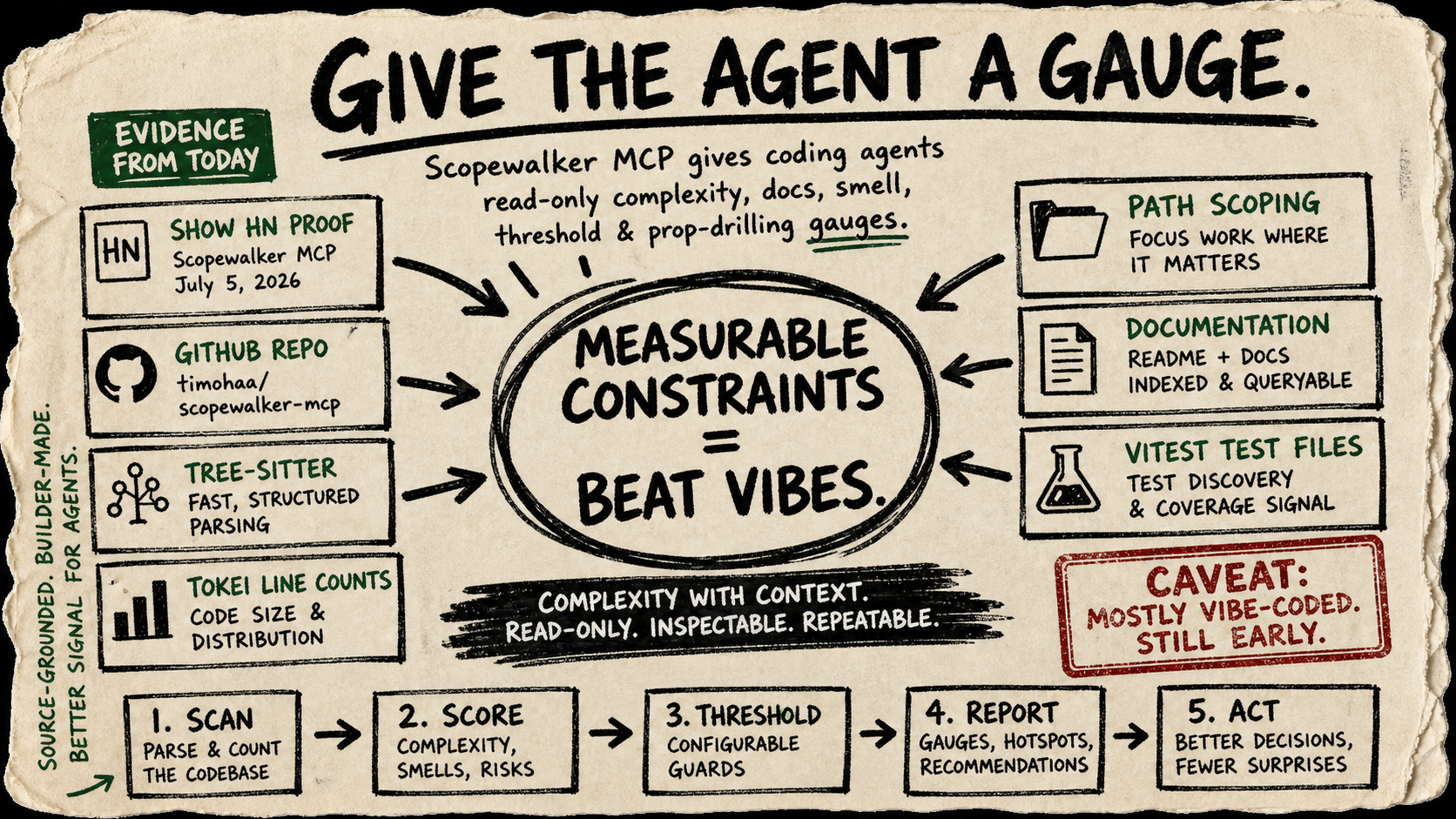
The public proof is direct: the Show HN post says Scopewalker is mostly vibe-coded, refined over months, tested with Claude Code, and published as an open-source local MCP server for codebase complexity metrics.
The engineering lesson is not "let the agent write more code." It is: give the agent numbers. Scopewalker exposes line counts, functions, cognitive complexity, size thresholds, documentation coverage, code smells, and prop-drilling evidence as tools instead of hoping a rule file is remembered.
The Engineering Receipt
The repo is not a thin wrapper. Its TypeScript server registers eight MCP tools, strips rejected JSON-schema metadata before tool listing, scopes paths to the current working directory or allowed roots, and uses tree-sitter, tokei, and fast-glob rather than custom string parsing.
Why It Is Not A Five-Minute Demo
The public source includes language fixtures, tree-sitter parsing tests, threshold tests, code-smell tests, documentation-coverage tests, prop-drilling analysis, response helpers, file guards, and path validation. The README also documents no-network operation, large-file guards, output limits, and comment redaction.
What Builders Can Steal
The transferable skill is to convert standards into local, read-only instruments. An agent that can query oversized files, undocumented exports, unsafe casts, and forwarded parameters has a better chance of respecting engineering constraints than an agent that only reads prose instructions.
Caveat
The evidence does not prove broad adoption or perfect metrics, and the builder describes the project as AI-assisted rather than hand-audited from first principles. What to watch is whether Scopewalker keeps its safety defaults while adding deeper language support and real project feedback.