Daily Edition Sources +5

API Discovery: RNB Turns Buildings Into Agent-Readable IDs

Compact source brief, not the lead: the RNB building API is narrow but useful because it gives agents a public building identifier before they draft local permit, retrofit, insurance, or asset records.

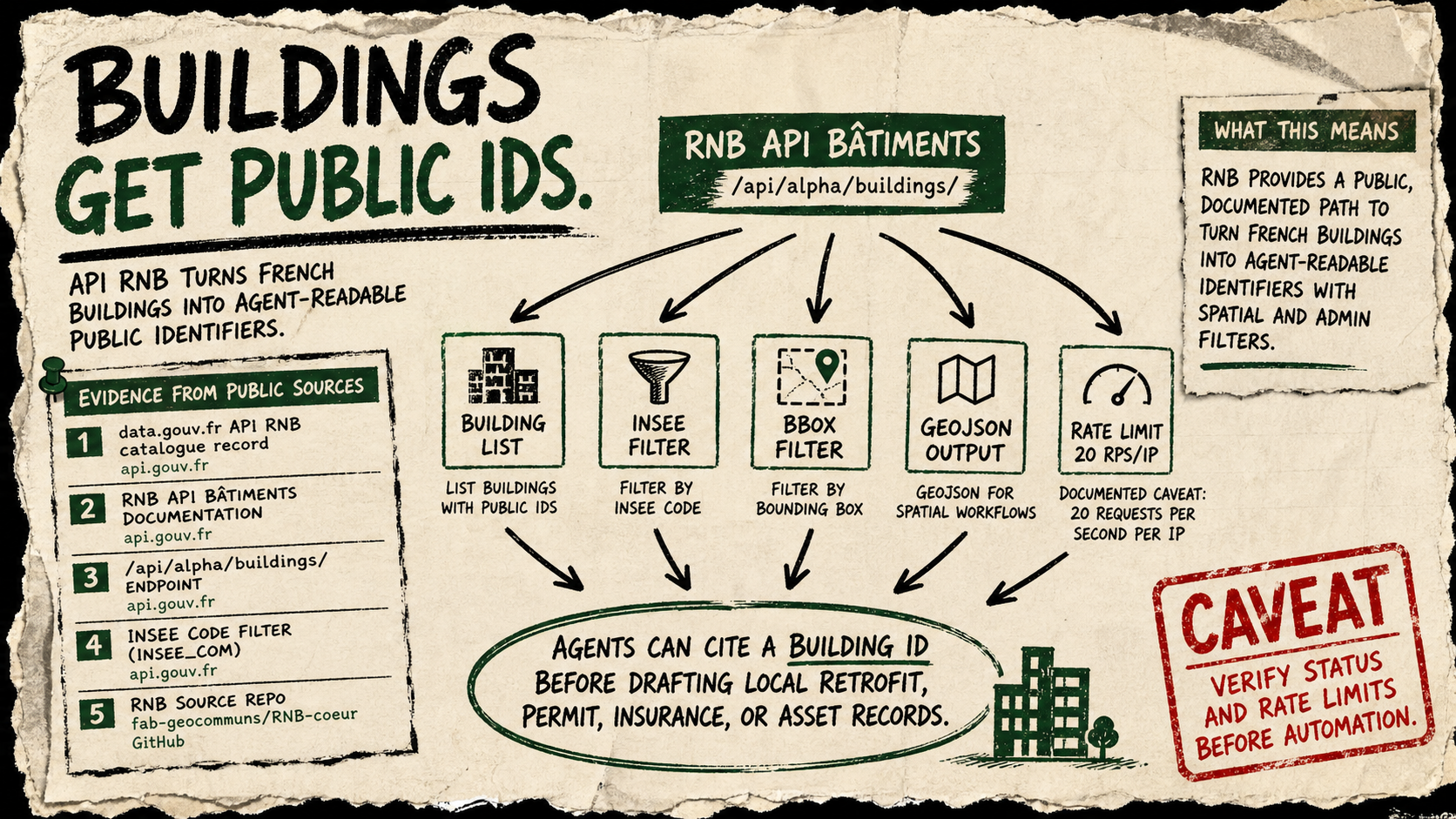
Diagram Punk poster showing the RNB building API turning addresses into public building IDs with documentation, endpoint, INSEE, bbox, and rate-limit caveat cards.
Diagram Punkbuildings get public IDs.
repos source trail evidence
5 source signals 0 repos 5 source signals
Evidence: 5 source signals / July 8, 2026 / Daily Edition
Open Edition Evidence below

API discovery: The data.gouv.fr API RNB catalogue record points to rnb-api.beta.gouv.fr and the RNB docs for listing buildings by INSEE code, bounding box, status, BAN key, or GeoJSON format.

Why This Is Compact

The source is a focused API definition, not a same-day software change. It belongs as a compact operator brief because the decision is simple: verify a building ID before asking an agent to reason about a physical address.

Creative Example

An urban-retrofit assistant could take a Paris address, call the RNB building list or search endpoint, store the ID-RNB beside the address, and only then draft grant, audit, insurance, or works-permit questions for a human reviewer.

Copy-Paste Agent Instruction

Use the RNB docs at https://rnb-fr.gitbook.io/documentation/api-et-outils/api-batiments/lister-des-batiments.md. Build a minimal GET request to https://rnb-api.beta.gouv.fr/api/alpha/buildings/ with an INSEE code or bbox, limit results to 1-5, report each rnb_id, status, address source, and caveat before drafting any building-specific recommendation.

What To Check First

What to watch: rate limits and data status. The docs name a 20-requests-per-second-per-IP limit, and a test call for insee_code=75056&limit=1 returned a constructed building with an ID-RNB and address metadata.

Evidence Trail

Receipts below the story

The article above is the public narrative. This section keeps the source trail and limits on the same page.

Edition
DateJuly 8, 2026
LaneDaily Edition
Confidence78%
Sources5
Repossource trail

Primary Evidence

Evidence Limits

  • The evidence does not prove any specific building status is current without checking the returned API fields.
  • The brief does not claim the API is suitable for high-volume automation beyond documented rate limits.
  • What to watch: agents that store ID-RNB alongside addresses before drafting local building-specific recommendations.
Letters & Corrections

Send a note to the desk

Corrections, missing context, or a follow-up lead.