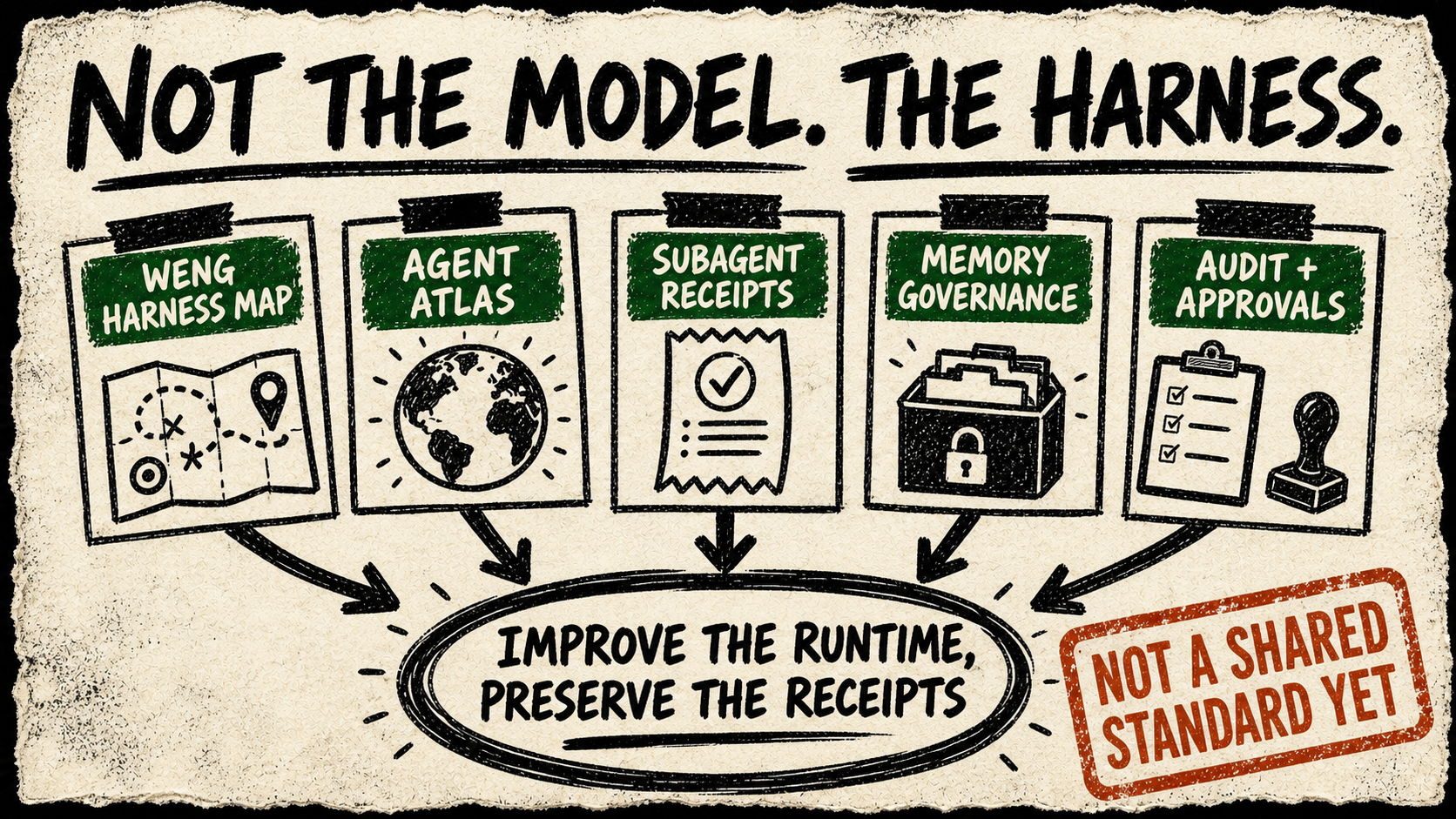
Lilian Weng published "Harness Engineering for Self-Improvement" on July 4, and the useful way to read it is not as another recap of agent papers. It is a field note about where practical self-improvement is likely to show up first: in the code that surrounds the model.
That matters to TheGitReporter because our daily source trail has been circling the same layer from below. Codex subagent receipts, OpenWork memory governance, Hermes approval isolation, OpenClaw audit ledgers, Pi compaction visibility, and OpenCode tool contracts all look like ordinary product or repo changes until Weng's frame gives them a common name. They are harness work.
The Layer Weng Names
Weng's essay defines the harness as the system around a base model: the workflow, tools, context, memory, artifacts, permissions, execution control, and evaluation machinery that decide how the model actually works in the world. The post then organizes current research around patterns that builders already recognize: workflow automation, filesystem memory, subagents and backend jobs, context engineering, workflow search, self-harness loops, evolutionary program search, and eventual joint optimization with model weights.
The important move is that self-improvement does not have to begin with a model rewriting its own weights. A near-term agent can improve the scaffolding that gives the model better context, clearer tools, better failure records, stronger tests, and more useful feedback. That is still real improvement. It is also more inspectable than a mysterious jump in model capability.
This is where Agent Atlas and Weng's essay meet. Atlas separates the model, runtime, operator, executor, and environment so failures do not become folklore. Weng adds another question above that stack: which parts of the runtime can become the object of optimization, and which parts must stay outside the loop as safeguards?
What Our Source Trail Already Saw
The July archive reads differently under the harness frame. Codex giving subagents delivery receipts was not only a UI or delegation detail. It made parallel agent work easier to inspect after the fact. OpenWork turning team memory into a governed surface was not only a feature story. It showed that useful memory has to carry scope, search, deletion, and caveats.
Hermes moving approval state into thread-local runtime state and OpenClaw adding a metadata audit ledger point at the same field pressure. The model may propose, but the harness decides whether a request is routed to the right session, whether approval belongs to the right thread, whether an event gets logged, and whether an operator can reconstruct what happened without reading an entire transcript.
The older Atlas chapters make the continuity clearer. Before the first model request, the runtime has already assembled instructions, tool modes, permission profiles, and task records. In the delegation chapter, the hard problem is not merely spawning more workers. It is preserving lineage, budgets, tool scope, and return receipts. In the memory chapter, "memory" splits into user preference, project context, retrieved docs, compaction output, and durable artifacts with different lifetimes.
Weng's essay raises the stakes on those distinctions. If harness design becomes an optimization target, every hidden shortcut becomes a future failure mode. The system can only improve what it can measure, preserve, compare, and safely edit.
The Constructive Program
The positive version of harness engineering is not "let the agent rewrite everything." It is to make the machinery around the model explicit enough that builders can improve it without turning trust into guesswork.
That starts with persistent traces. A long-horizon agent should not carry the whole project in chat context or pretend that a summary is the same thing as evidence. It should write artifacts, logs, diffs, failed attempts, evaluation results, rejected proposals, and state updates into places that a human and a later agent can read. Filesystem memory is not glamorous, but it is a discipline: keep the work inspectable after the context window moves on.
It continues with bounded editable surfaces. Weng's discussion of self-harness loops is strongest when proposed harness edits are mined from concrete failure patterns, tested against held-in and held-out tasks, and accepted only when they do not regress. That is a software engineering shape, not a vibes shape: isolate the change, preserve what passed, log what failed, and do not let the optimizer quietly change the yardstick.
The same lesson applies to workflow search and evolutionary methods. A coding agent can explore a large design space when the candidate is code, the evaluation is real, and the history is preserved. But the search is only as good as the fitness signal. If the target is a unit test, the agent may overfit the test. If the target is a judge, the agent may learn the judge. If the target is a benchmark, the harness may become a benchmark exploit machine.
The Boundary That Must Not Move
Weng is careful about the hard edge: permission controls, security layers, and evaluation should not be swallowed by the same loop that edits the harness. That line should become field doctrine.
The reason is practical. A self-improving harness is allowed to change how work is framed, delegated, remembered, and retried. If it can also change who is allowed to approve actions, which evidence counts, which failures are recorded, or which tests are held out, then improvement turns into self-justification. The system can become better at winning its own game while becoming worse for maintainers, operators, and users.
TheGitReporter's recent Codex usage deep dive is a small product example of the same tension. Background work became user work when auto-review, subagents, suggestions, retries, and usage displays blurred what the system did on the user's behalf. That was not recursive self-improvement, but it was a warning about hidden harness labor. When the surrounding system becomes more active, the accounting and consent surfaces have to become more explicit.
A Field Standard Worth Building Toward
A net-positive outcome from Weng's essay would be a shared inspection habit for agent infrastructure. Before a team says its agent is self-improving, the field should ask whether the harness can answer six ordinary engineering questions.
- What changed? The harness edit should be a source-visible diff, configuration change, prompt artifact, workflow graph, or evaluation rule that can be reviewed.
- Why did it change? The system should point to failure traces, successful traces to preserve, and the causal mechanism the edit is meant to address.
- What stayed outside the loop? Permission brokers, secret handling, held-out tests, audit policy, and human approval checkpoints should be harder to rewrite than the harness logic being optimized.
- What failed? Negative results, rejected edits, flaky evaluations, abandoned hypotheses, and regression cases should be first-class memory, not cleanup debris.
- Who can inspect it? Operators should get receipts: context lineage, subagent lineage, tool calls, approvals, evaluation outcomes, and failure summaries in durable artifacts.
- What long-term cost was checked? The evaluation should look beyond task pass rate toward maintainability, ownership boundaries, migration burden, rollback, and future debugging.
That standard is modest on purpose. It does not require every builder to run an evolutionary search system or publish a research harness. It asks agent teams to treat harness changes as infrastructure changes: diffable, testable, reversible, and legible to the people who will live with the system after the demo.
How To Read The Next Agent Patch
Weng's essay should change how builders read ordinary agent commits. A memory patch may be a context-lifecycle improvement. A subagent patch may be a process-manager improvement. An approval patch may be a permission-boundary repair. An audit patch may be evaluation infrastructure. A failed experiment log may be more valuable than a polished success demo because it trims the search space for everyone else.
This also gives TheGitReporter a sharper bridge between the Daily Edition and Agent Atlas. The Daily Edition catches source-visible movement before the official narrative is tidy. Atlas turns repeated movement into reusable concepts. Weng's harness essay supplies the forward-looking research map: once the runtime itself becomes the optimized object, our job is to keep asking what evidence, caveat, and human decision point makes the improvement trustworthy.
Limits
The evidence here is deliberately layered. Weng's post is a public research synthesis, not a product release. The cited Daily Edition pieces are source receipts from individual projects, not proof of a coordinated standard. The Atlas chapters are an interpretive model built from prior reporting. Together they show a direction, not a settled field consensus.
The constructive read is still strong. Harness engineering gives the field a practical place to make agents better without pretending that every improvement must happen inside model weights. The responsible version is evidence-first: preserve the traces, bound the editable surface, keep permission and evaluation outside the loop, and make enough of the machinery public that other builders can learn from it.