The public proof of coding-agent use is in the ContextMatrix README: its ecosystem includes a frozen `contextmatrix-runner` backend that ran Claude Code headless in disposable containers, while the current topology moves task execution to `contextmatrix-agent` plus chat.
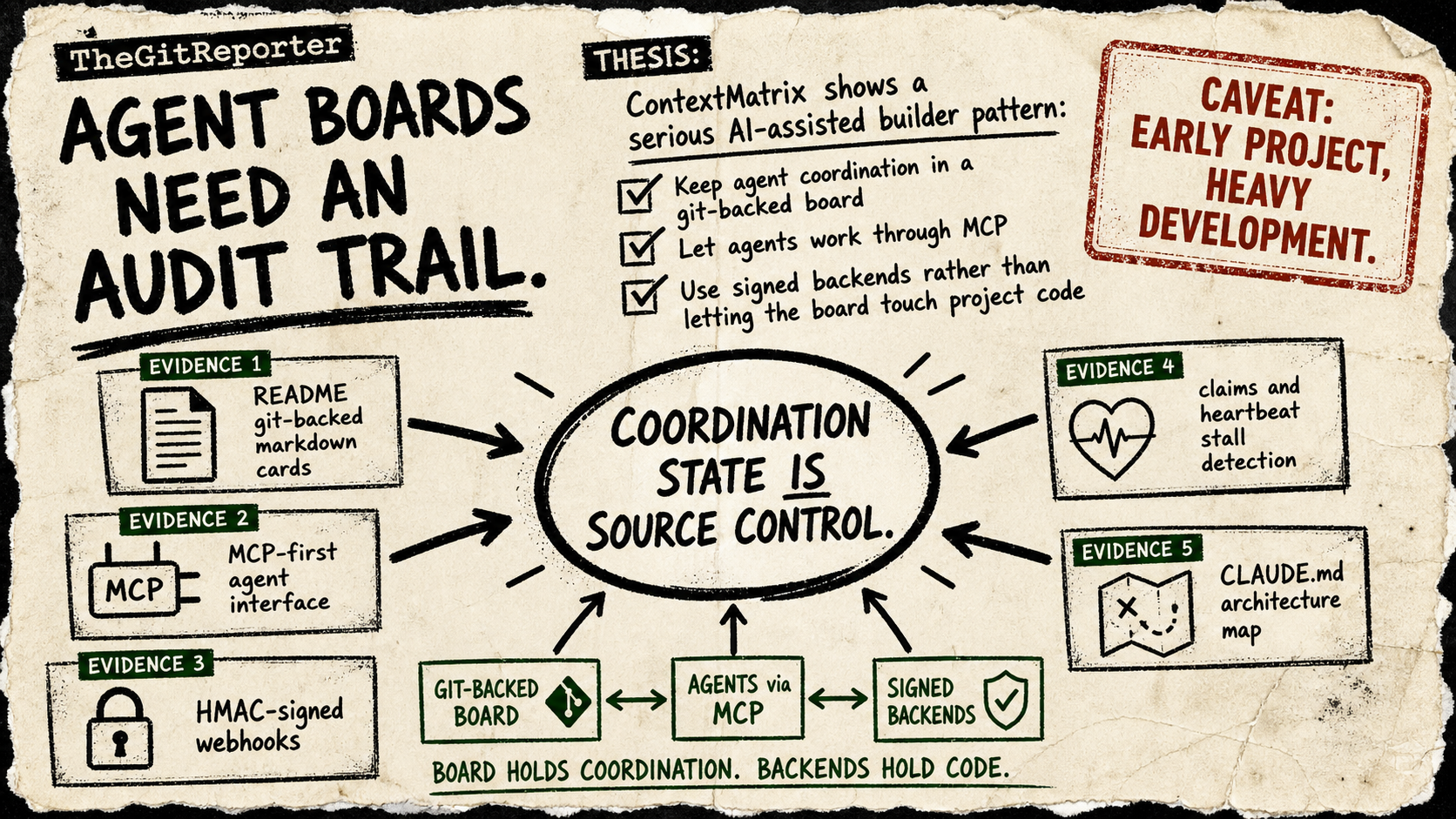
The engineering depth is the split. ContextMatrix tracks markdown cards in a separate git-backed board repository, exposes REST, web UI, and MCP tools, signs backend webhooks with HMAC, and requires claims, heartbeats, and state transitions before parallel agents can touch work.
The craft
The transferable skill is boundary design. The board never touches project code repositories; it stores coordination state, dispatches cards, and lets backends work elsewhere. That makes the audit trail durable without turning the coordination server into a privileged build worker.
The receipts
The README names markdown-native cards, auto-committed mutations, 28 MCP tools, HMAC-signed webhooks, image attachments surfaced to agents, token-cost reporting, and a single embedded Go/React binary. The repo inspection found matching packages under `internal/mcp`, `internal/gitops`, `internal/lock`, `internal/runner`, `internal/chat`, and `workflow-skills`.
Why it is not five-minute code
This is not a wrapper around a model call. It has auth modes, credential pools, SSE updates, cost archive, GitHub issue import, agent claims, stall detection, workflow skills, backend parity docs, and tests around runner reconciliation. The caveat is maturity: the README warns that the project is under heavy development. What to watch is whether the agent/chat split stays simpler than the frozen Claude Code runner it replaces.