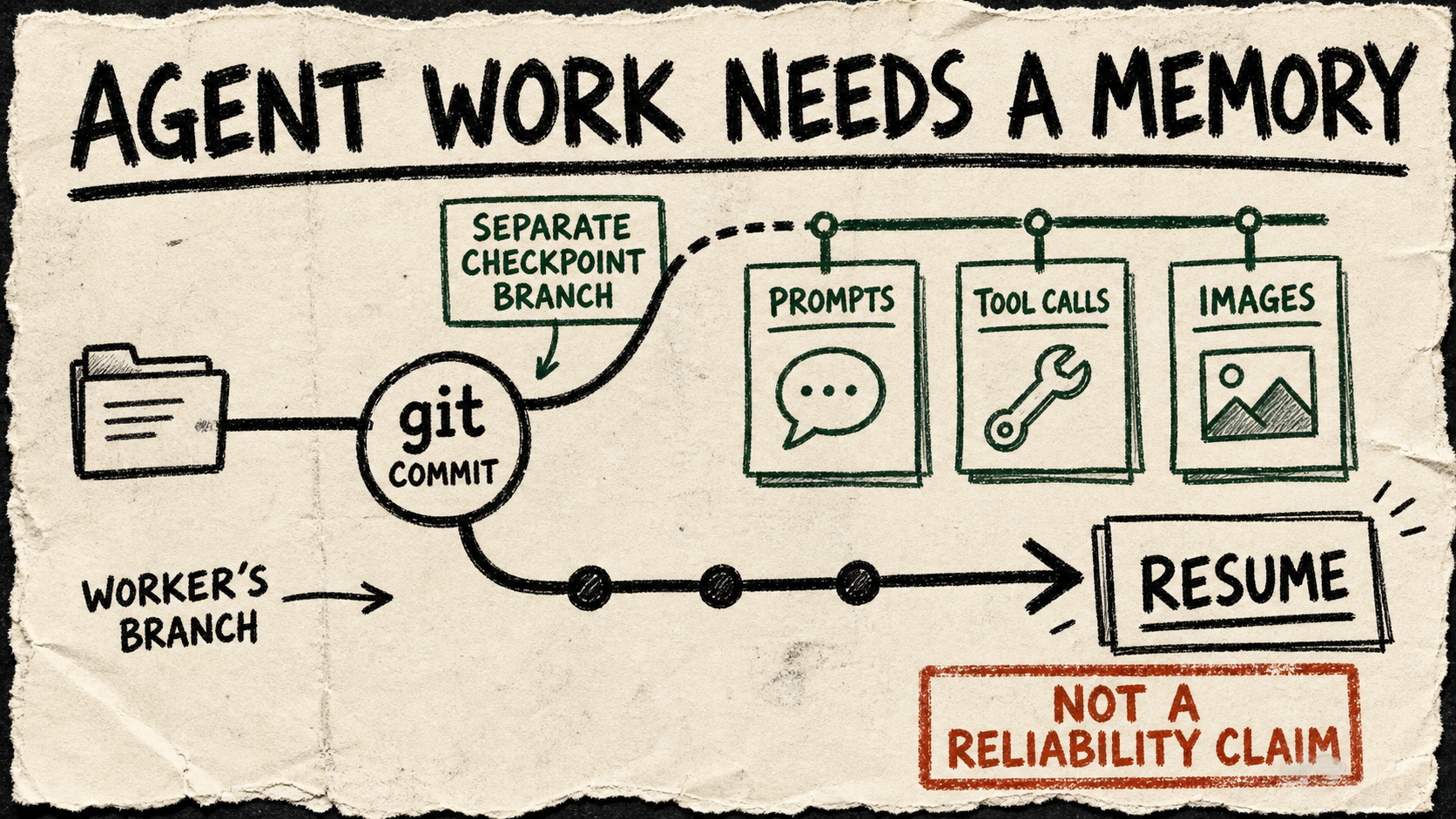
The code change is easy to miss because it lives beside the code it records. In the public entireio/cli repository, agent-session metadata lives on a dedicated entire/checkpoints/v1 branch rather than on a developer’s working branch. Its latest merged work adds durable image extraction for Claude Code, Codex, and Cursor sessions; nearby changes make imported sessions visible but read-only and teach resume to look for remote branches.
That makes Entire’s more interesting trajectory less like “another agent wrapper” and more like an attempt to give the messy middle of AI-assisted work a recoverable address in Git. For a team that needs to answer how a change was made—or pick up a half-finished session on another branch—the practical question is whether the record can travel without silently contaminating the code history it is meant to explain.
A separate branch for the receipts
Entire’s README says its hooks capture prompts, responses, touched files, tool calls, and session data alongside commits, while leaving the active code branch alone. The new image-externalization merge reaches into checkpoint persistence, condensation hooks, image extraction, and integration tests. That is a concrete sign that the project is expanding the record it preserves from text transcripts toward the richer artifacts modern coding agents exchange.
The recent imported-session work adds state and list handling for sessions brought in from elsewhere, while checkpoint-resume work adds remote-branch fallback. Together, those are implementation receipts for a handoff problem: a record is useful only if it remains recognizable after it leaves the machine or branch where it began.
The hard part is not capture—it is safe recovery
Entire’s own privacy documentation supplies the challenge to the first, optimistic reading. It says transcripts can include file contents and MCP calls; its temporary shadow branches may contain raw source snapshots, and public repositories make checkpoint data public. The project ships redaction passes and warns users not to push shadow branches manually. That turns “memory for agent work” into a data-governance choice, not an automatic safety upgrade.
The evidence supports a specific watch item: look for whether Entire can make its branch separation, redaction boundaries, and resume semantics legible to teams operating across devices and repositories. The commits and tests show an implementation direction, not adoption, reliability in production, or a verdict on whether every project should preserve agent transcripts at all.