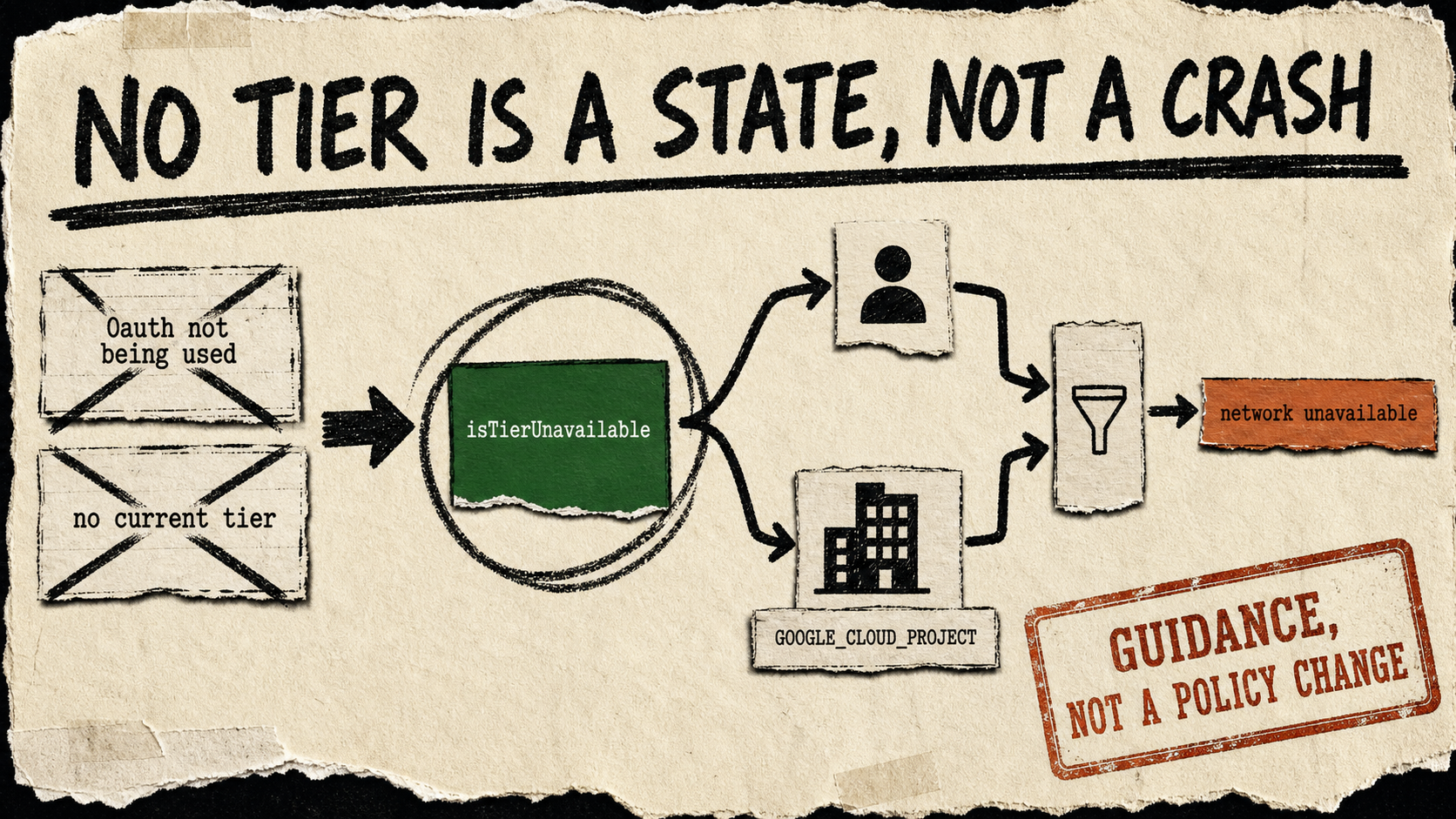
Gemini CLI's main branch now treats the absence of a consumer Code Assist tier as an account-routing state, not a privacy-system crash. The July 10 patch replaces several raw failure paths with a notice: the free-tier service-improvement opt-in is unavailable here, and Workspace or enterprise users should use a Google Cloud project path.
That sounds like a small wording fix until the public issue trail supplies the user situation. A company-account user asked how to opt out and determine which tier was active after /privacy returned a current-tier error. An enterprise report described the command as a check on whether a Cloud project had routed a team into its intended governed service. The reports prove confusion at a policy boundary, not that any prompt was leaked or served under the wrong terms.
An inapplicable control is not an outage
The code adds isTierUnavailable for four expected states: no Code Assist server, no project ID, no resolved user tier, or the backend's specific “does not have a current tier” response. The distinction is deliberately narrow. A test that returns network unavailable still produces an error, rather than being hidden behind friendly account guidance.
The new notice offers no Yes/No toggle. It points organization users toward GOOGLE_CLOUD_PROJECT, the official authentication guide, and an exit. That matters after Google's June 18 consumer-tier deprecation: this is best read as cleanup for an enterprise/no-tier account boundary, not a new consumer privacy feature.
Clarity is useful; verification would be better
Only UI, hook, and test files changed. The patch does not route an account, change telemetry, or display the effective project, entitlement, service, or privacy contract. The next useful signal is a tagged release plus an end-to-end organization-account check that can name the active boundary instead of merely explaining why one switch is missing.