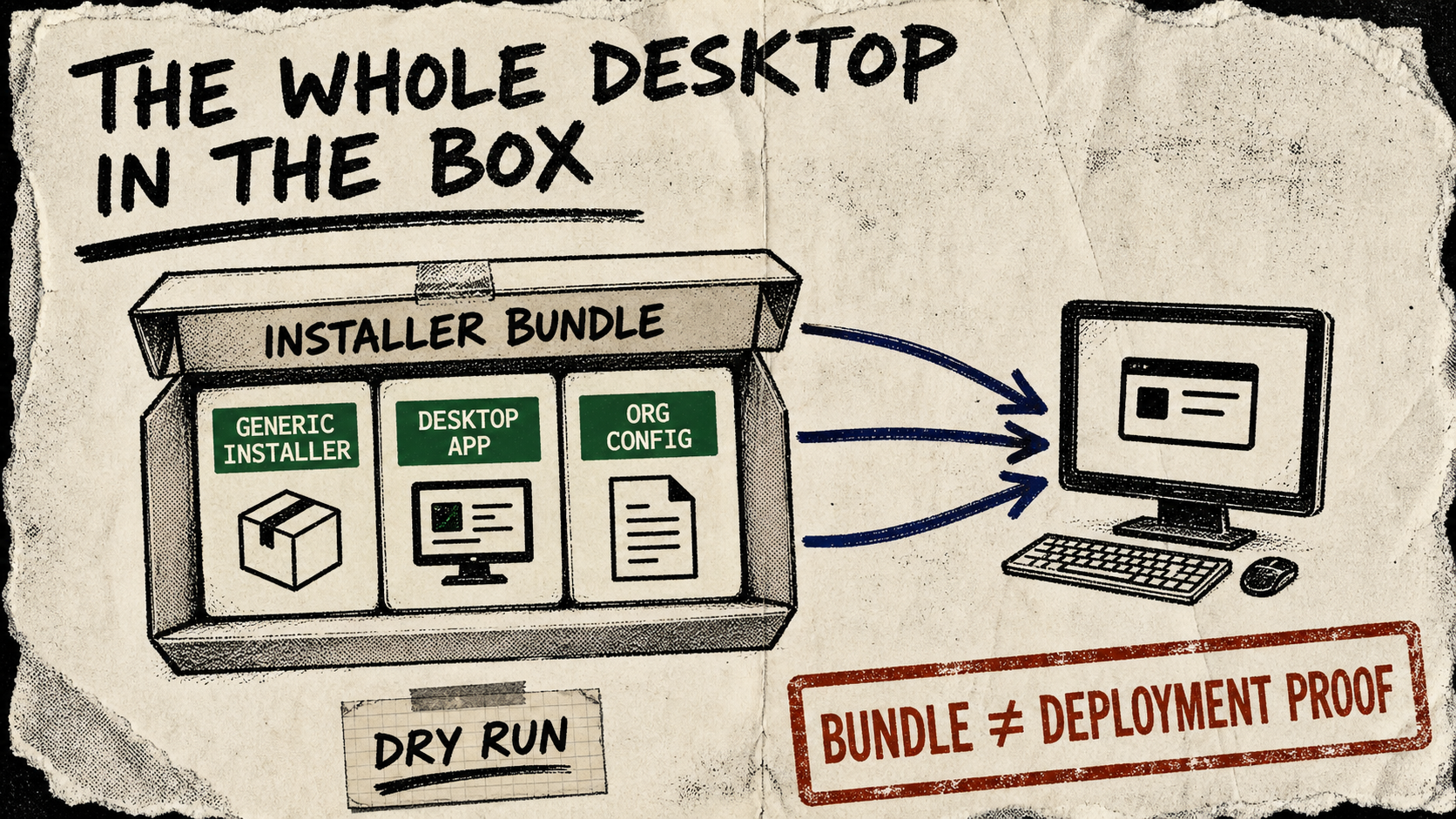
An installer that must phone home is a poor fit for an organization with an air gap. OpenWork’s July 11 change makes that constraint concrete: its organization download can now package a generic installer, the unchanged desktop artifact, and the organization’s explicit configuration in one bundle.
The first reading was simply “offline installation.” The code and tests make the more useful story narrower. The installer does not merely cache an executable. It chooses an exact version, looks for the exact adjacent artifact, writes the configuration as an explicit provisioning choice, and tests that a dry run can finish without contacting the release host. That is a contract about repeatability.
A bundle replaces an assumption
In apps/installer/src/install.ts, the installer first resolves the requested release artifact beside the bundle. Only when it is missing does it fall back to a network download. Its dry-run path also skips the release-host check when that exact artifact is present. The surrounding test constructs a bundled artifact and verifies that result.
The organization route is the other half of the public situation. install-links.ts packages the generic installer, the standard desktop app, and the organization sidecar together. An organization can therefore distribute the thing that configures the app alongside the thing being configured, instead of relying on a later network fetch or a silent hosted default.
Why the explicit choice matters
The change also removes a prior preference for preserving an installed organization deployment over a hosted configuration. In the new path, a confirmed installer writes the deployment selected by that bundle while retaining unrelated prepared state and removing one-time handoff grants. That is a small but meaningful distinction: setup becomes a deliberate, reproducible action, not an accident of whichever desktop configuration was found first.
This is a Daily Story because it makes a public pressure visible: organizations distributing an agent workspace may have to operate where “download the latest app” is unavailable or unacceptable. The source does not prove that any particular customer uses an air-gapped deployment, nor does a dry-run test prove every platform installation succeeds. The next useful signal is a release artifact and real installation documentation that expose how the bundle behaves outside the test harness.