Daily Edition Sources +3

Builder Work: Saracroche Keeps the Whole Boundary in View

The transferable lesson in Saracroche’s AI-assisted iOS work is not “use less AI.” It is to trace every state transition across an extension boundary before delegating a local implementation.

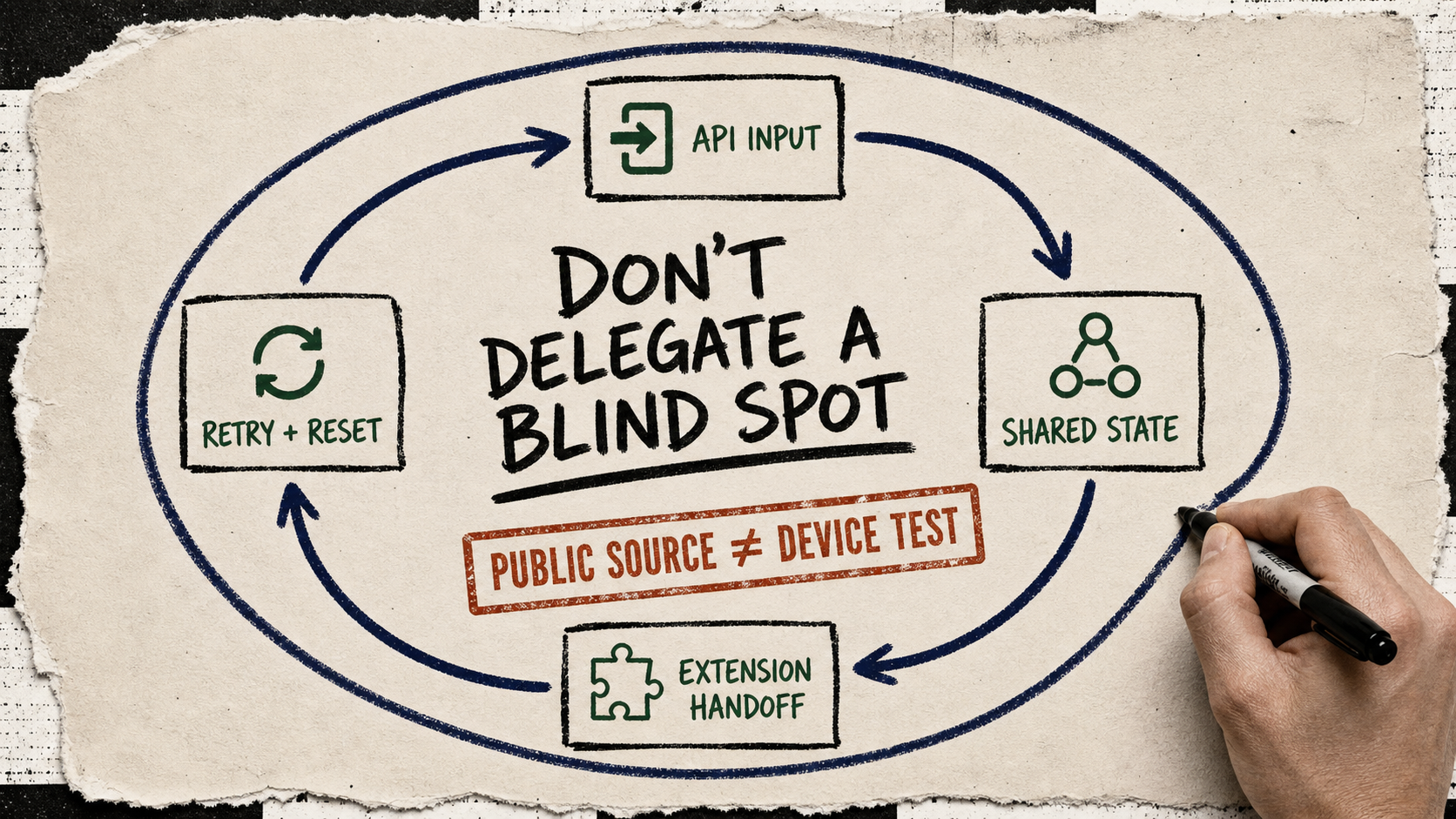
Diagram Punk poster showing API input, shared state, extension handoff, and retry/reset in one loop, with a warning not to delegate a blind spot.
Diagram Punkthe state boundary is the thing to keep visible.
repos source trail evidence
3 source signals 0 repos commit d9fc924
Evidence: commit d9fc924 / July 12, 2026 / Daily Edition
Open Edition Evidence below

Camille Bouvat’s public retrospective says that delivery pressure and too much final delegation to Claude contributed to bugs and to losing familiarity with parts of Saracroche. His correction was function-by-function assistance and AI as a second opinion. The useful Builder Work receipt is that this change in practice maps directly to a repository full of coupled state.

The repo evidence

At commit d9fc924, a remote list is reconciled in ListService, persisted in a shared App Group database, expanded and chunked in BlockerService, then consumed by a different CallKit process. The reset history in PR #175 and its successor shows the team revising how expired and failed patterns become eligible again.

That is why this is not five-minute generated-wrapper work. The hard part is the contract between API input, shared state, a one-action handoff, a separate extension, completion records, retries, and reset rules. Any one function can look reasonable while the boundary is wrong.

The transferable skill

Draw the state loop before asking an agent to change it. Name the source of truth, the serialized handoff, the consumer, the acknowledgement, and the recovery path. Then give an agent one bounded job inside that loop—such as making a reset idempotent or adding a reconciliation test—and review the whole loop, not just its diff. That is how an assisted implementation stays legible to its maintainer.

The public source supports Bouvat’s account of AI-assisted development and the architecture above. It does not prove which lines any tool wrote, that the current App Store binary matches the inspected commit, or that every recovery path is device-tested. A public suite around expansion, removal-before-add, and retry behaviour would be the next stronger engineering receipt.

Evidence Trail

Receipts below the story

The article above is the public narrative. This section keeps the source trail and limits on the same page.

Edition
DateJuly 12, 2026
LaneDaily Edition
Confidence78%
Sources3
Repossource trail

Primary Evidence

  • Public coding-agent use proof: https://cbouvat.com/blog/1an-saracroche/
    • Shows: maintainer Camille Bouvat publicly describes AI-assisted development with Claude, says delegating too much final work contributed to bugs and reduced code familiarity, then describes moving to bounded assistance and second-opinion use.
  • Inspected GitHub repository: https://github.com/cbouvat/saracroche-ios/commit/d9fc9249b0519bfa54ec21a68ad7b8703404df58
    • Shows: the inspected source tree contains concrete code modules for ListService reconciliation, App Group persistence, BlockerService chunking, SharedUserDefaults handoff, and the separate CallDirectoryHandler consumer.
  • Engineering receipt: https://codeberg.org/cbouvat/saracroche-ios/pulls/175
    • Shows: public recovery work changed how expired and failed patterns become eligible for reprocessing; the state boundary includes retries and reset policy, not a one-shot API call.

Evidence Limits

  • The evidence establishes public agent use and a non-trivial Codeberg repository, not the authorship of individual lines, full test coverage, device success, or a claim that assistance caused every design decision.
Letters & Corrections

Send a note to the desk

Corrections, missing context, or a follow-up lead.