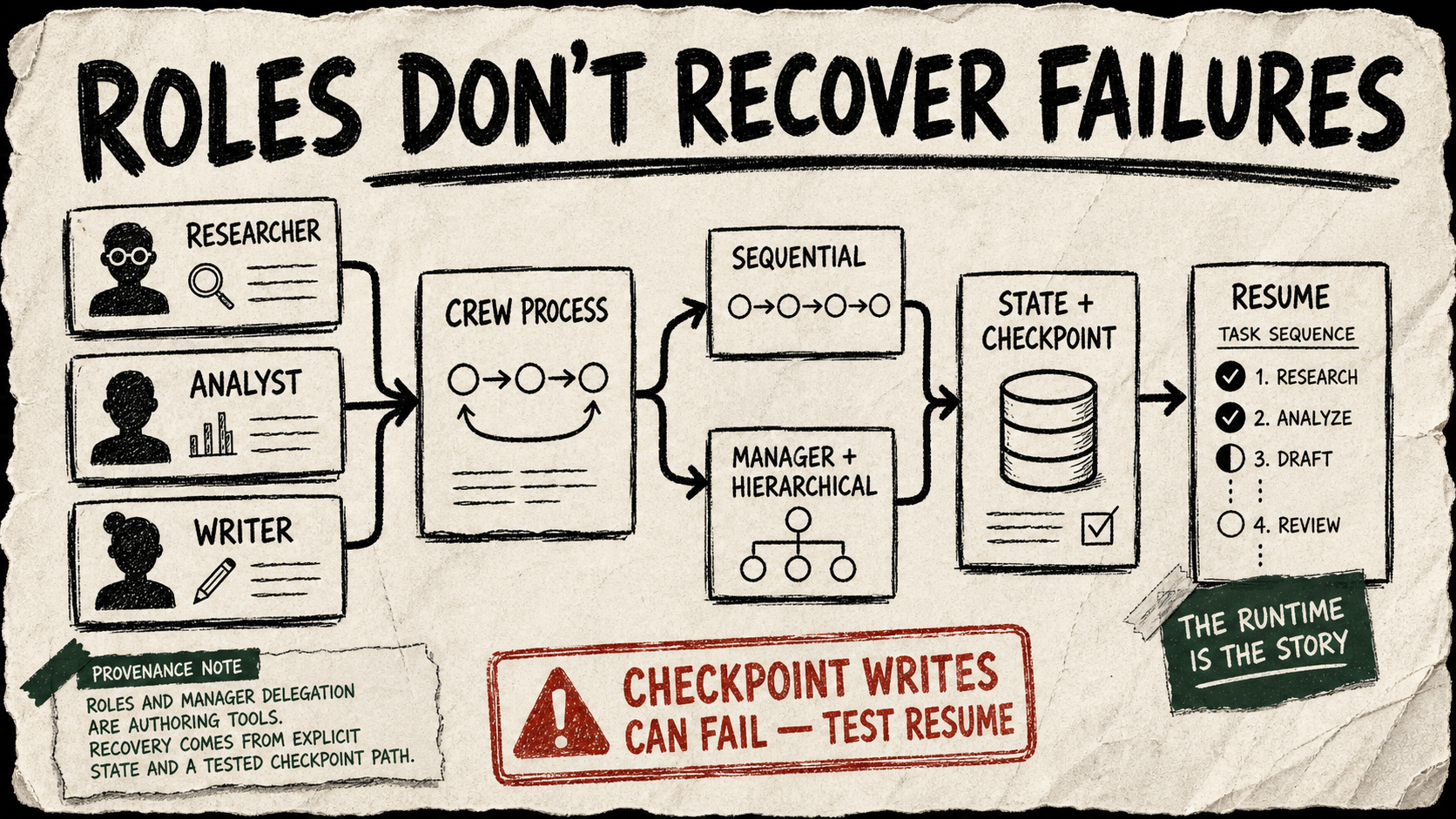
It is easy to make a crew look like a company. Give one model the title Researcher, another Analyst, another Writer; add a manager; draw arrows. The current CrewAI documentation snapshot makes the more consequential part visible. A crew has named agents and tasks, but it also chooses a process, owns execution state, exposes callbacks and tracing, and can opt into checkpointing. The question after the demo is not whether the names sound collaborative. It is whether work can be interrupted without losing the only reliable account of what already happened.
The first reading of CrewAI was the familiar role-based metaphor: the framework can make a group of language models feel like a small organization. That is true, and the documented process choices encourage it. A crew is sequential by default. A hierarchical crew needs a manager model or a manager agent, which can allocate and review tasks. But the public runtime punctures a useful hole in the metaphor: after the manager is created, both paths reach the same task executor.
The crew is a scheduler, not a cast
That executor walks the configured tasks. It constructs each task's context from preceding outputs, starts asynchronous tasks when they are marked that way, waits for pending futures before later synchronous work, and records outputs as it goes. In hierarchical mode the manager is a real intervention: it gets delegation tools, becomes the executing agent, and can plan, assign, and validate. It is not a separate, magical coordination plane. The work still needs a legible order, a boundary around what may run concurrently, and an account of which output should be trusted by the next task.
That distinction matters for builders who are moving from a convincing prototype to a system someone must operate. A role prompt may improve task decomposition. It cannot tell an operator whether a half-finished research step was already written to a database, whether a tool call should be repeated, or which manager instruction existed when the run stopped. Those are runtime questions, and CrewAI's source is clearest when it treats them as such.
Where the state becomes visible
CrewAI puts the other half of the answer in Flows. Its Flow documentation describes method-level orchestration with explicit state and memory; a Flow can call a Crew without making the crew's role list the entire application architecture. That is the more mature division of labor. Crews are useful for task-and-agent composition. Flows give an application a place to name inputs, state transitions, external handoffs, and decisions that should survive beyond a single model turn.
The fresh checkpointing contract makes the cost of that choice concrete. A checkpoint can capture configuration, agent memory and knowledge sources, task progress, intermediate outputs, internal state, kickoff inputs, event history, and lineage. Restoration rebuilds that state, skips completed tasks, and can fork a new branch. JSON storage is inspectable; SQLite is offered for higher-frequency writes. The runtime source goes further than the brochure language: on restore it rebinds agents and tasks, reconnects memory views, restores the event scope, and starts at the first task without an output.
That is valuable machinery, but it is not a free reliability certificate. CrewAI's own documentation says automatic checkpoint writes are best-effort: failed automatic writes are logged and the run continues. Nor can a framework infer whether an external side effect is safe to repeat. A task that drafted a paragraph is different from a task that sent an email, deployed a service, charged a card, or edited a production record. Recovery can restore the framework's idea of progress while the outside world retains an incomplete or duplicated action.
Turn the recovery path into the acceptance test
The transferable skill here is to write the interruption into the job's definition of done. Before assigning roles, list the durable state, the checkpoint event, the tool calls that have external effects, and the evidence that lets a resumed run decide whether to retry, reconcile, or stop. Then kill a disposable run after the first meaningful side effect and resume it. A successful result should show not merely that the final answer appeared, but that completed tasks were not silently replayed and that the operator can explain every action that was.
CrewAI has public building blocks for that discipline: a task executor, explicit flow state, checkpoint storage, and restore paths. The role cards remain useful, especially where a manager genuinely changes delegation. But the real line between a demo and an operating system is whether its next failure has a named state and a tested way back. The next signal worth watching is an end-to-end public example that interrupts a crew across a real external integration, resumes it, and shows the reconciliation rule—not just the final prose.