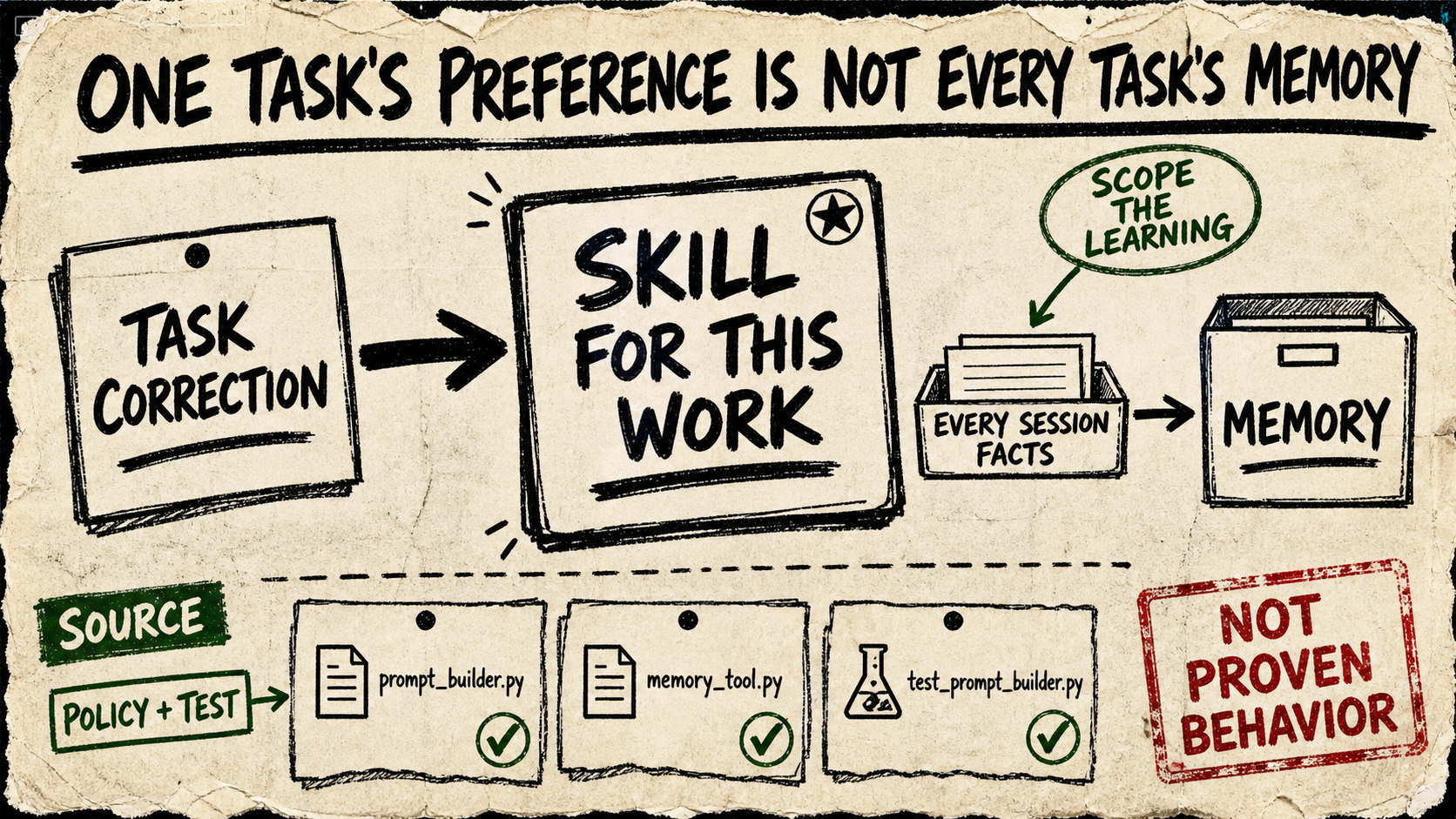
A user says, “Do not make that mistake again.” An agent has at least three places to put the lesson: the current conversation, a reusable procedure, or a profile that shows up in every future task. Treating those as the same thing is how a useful correction turns into background noise. A September 3 Hermes commit makes a clean public choice: task-learned procedures, pitfalls, preferences, and corrections should go to the skill used for that kind of work; memory is for facts that apply in every session.
That is less glamorous than a new model or a larger context window, but it describes the part of an agent that determines whether yesterday's help becomes tomorrow's interference. Hermes is publicly built around skills, cross-session search, and a persistent user model, so the boundary is not an abstract taxonomy. It decides whether a correction about a release checklist follows the next release checklist—or leaks into a conversation that has nothing to do with releases.
Global is a high bar
The changed prompt builder puts “skills come first” ahead of the memory instruction. In plain language, a procedure, a pitfall, or a preference tied to a kind of work should be saved where it loads only when that work is relevant. The new memory-tool description makes the counter-rule explicit: use persistent memory for facts about the user, stable environment facts, or standing conventions with no task home.
The distinction is easy to dismiss as prompt wording until you ask what it protects. A global memory entry has a large blast radius: it is injected into every future turn. A skill can hold a richer, more conditional lesson and stay dormant outside its domain. Hermes's public project description calls out self-improving skills and cross-session context; this change makes their separation an explicit operating rule rather than a hope that the agent will sort it out by instinct.
The test is about priority, not obedience
Hermes added a regression test that checks the skills-first rule appears before the memory exception. That is a meaningful receipt for the intended policy, not evidence that every model will follow it, that a generated skill will be useful, or that a user preference will never be misclassified. It also says nothing by itself about a tagged release or a privacy outcome.
Still, the useful question for anyone building a learning agent is now sharper: when a user corrects the work, what is the smallest future audience that needs the correction? If the answer is “this kind of task,” give it a task home. The next signal worth watching is a public runtime test or release note that traces a real correction through that route—stored, retrieved, revised, and kept out of unrelated sessions.