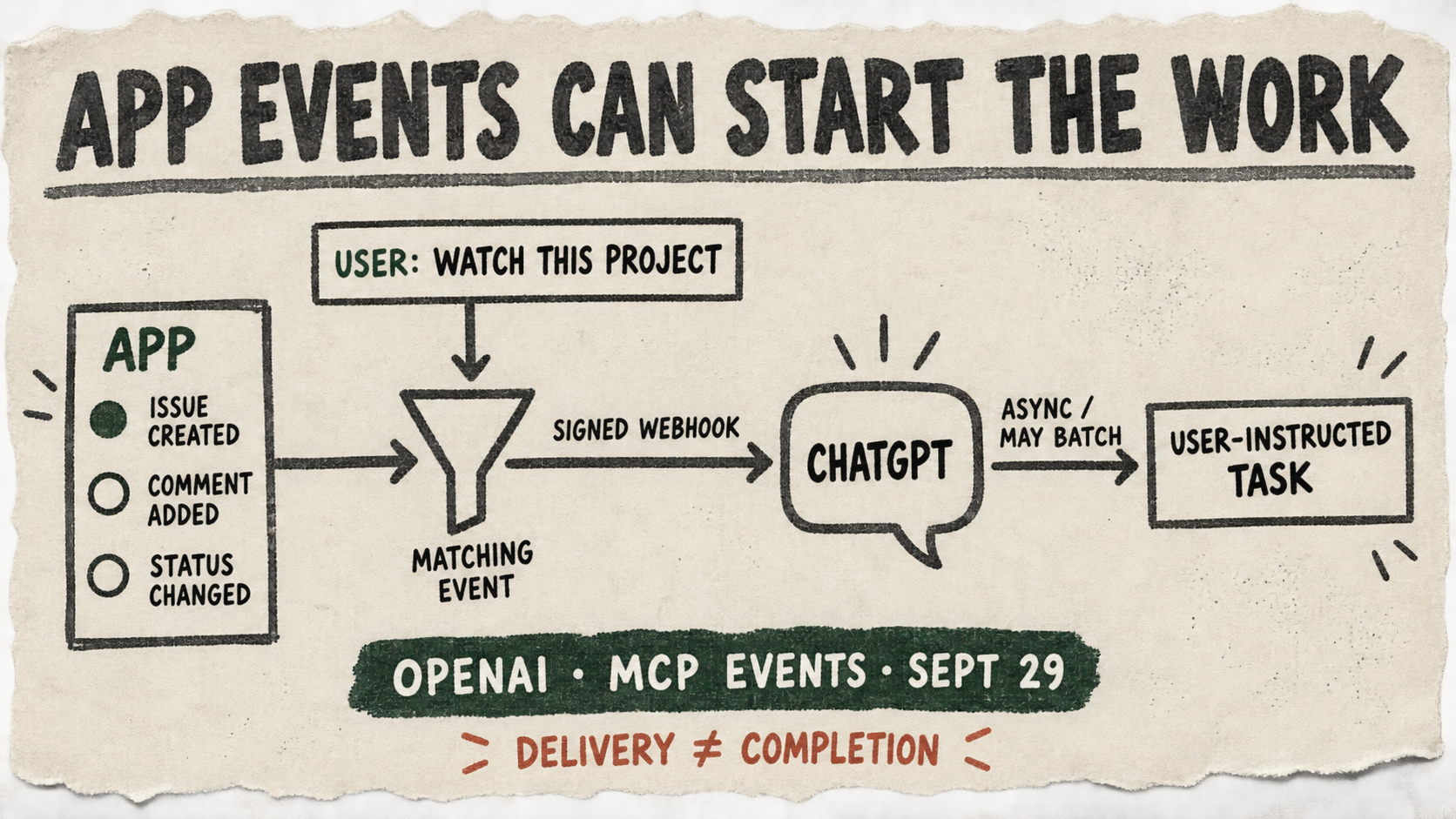
OpenAI has announced MCP Events for ChatGPT plugins: a connected app can start instructed work when something happens, without the user returning to send another prompt. The announcement, published September 29, gives a project-board example—watch for new tasks, then read their documents and draft a plan—and lists the capability as available to all plans.
For someone building a review tool or project tracker, the interesting addition is an event catalog. A plugin can describe the changes it offers to monitor, rather than merely the actions an agent can call. The user supplies the standing instruction. That gives software builders another way into the workday: through the moment a job becomes relevant. The public design in modelcontextprotocol/experimental-ext-triggers-events helps explain the proposed contract.
The subscription is the new interface
The published integration contract has the server list event types, accept subscriptions with filters, and send matching updates to a signed HTTPS callback. ChatGPT receives them in the subscribed chat. Builders need MCP 2.0, persistent subscription storage and outbound delivery; existing tools do not acquire this behavior automatically.
Consider a document-review plugin. Its useful promise could be modest: when a comment appears on one selected document, collect the relevant passage and prepare an edit for review. The product question becomes which event deserves attention, which document it belongs to, and what response the user actually wants. An event integration can be valuable without being allowed to publish the edit itself.
There is a separate contract underneath the message. OpenAI’s example uses the public Standard Webhooks signing library, whose implementation binds the identifier, timestamp and exact payload bytes into a signature. Its verifier checks time and signatures. That supplies inspectable delivery machinery; it does not tell us what ChatGPT’s private task runner does after accepting a message.
Notifications were already here
The strongest objection to a sweeping “agents become proactive” reading is the earlier record. The November 2025 MCP specification already let clients subscribe to a resource and receive a notification when it changed. A server sending news to a client is not the invention at this launch.
Nor is working while a user is away new to ChatGPT. OpenAI’s April 22 workspace-agent announcement described scheduled work and agents picking up Slack requests. It put further automatic triggers on the roadmap. The page now carries a newer availability banner, but the earlier product account is enough to rule out a first-ever claim.
What changes for plugin authors is the explicit description of a trigger: its name, allowed filters and delivered data. That is a different interface from telling a client that a particular resource changed. Our reading is that this is chiefly an integration and distribution development. It makes an existing automation pattern available through a conversational product and a discoverable plugin contract.
A product implementation, an unfinished common contract
The distinction matters because the MCP incubation repository explicitly remains exploratory. At the inspected September 8 revision, it contains a design sketch and supporting documents, not an executable reference implementation or conformance tests. The working-group charter identifies standardized callbacks and reference SDK implementations as its work. A vendor announcing support does not itself complete that process.
The draft design allows polling, streaming and webhooks, without making one delivery mode mandatory. It also ties replay to the upstream source’s ability to retain events. A common event description therefore does not, by itself, establish that two clients can consume the same subscription or recover the same missed work.
ChatGPT documents a webhook subset, excluding polling, streaming and the draft’s gap and termination notifications. A successful delivery response acknowledges receipt; processing happens asynchronously, and batching can combine events. This is not a promise of one immediate, completed task per event. We inspected public contracts and supporting source, not an authenticated subscription or ChatGPT’s server implementation.
For a builder, the next useful demonstration is a small end-to-end subscription: one chosen event produces the intended draft, a burst produces sensible work, and a restart preserves the watch. Then try the same event definition in another client. That would test both halves of the promise now on offer: work that starts at the right moment, and an integration the builder can carry beyond one host.