Browser Use: the control boundary between an agent and the live web
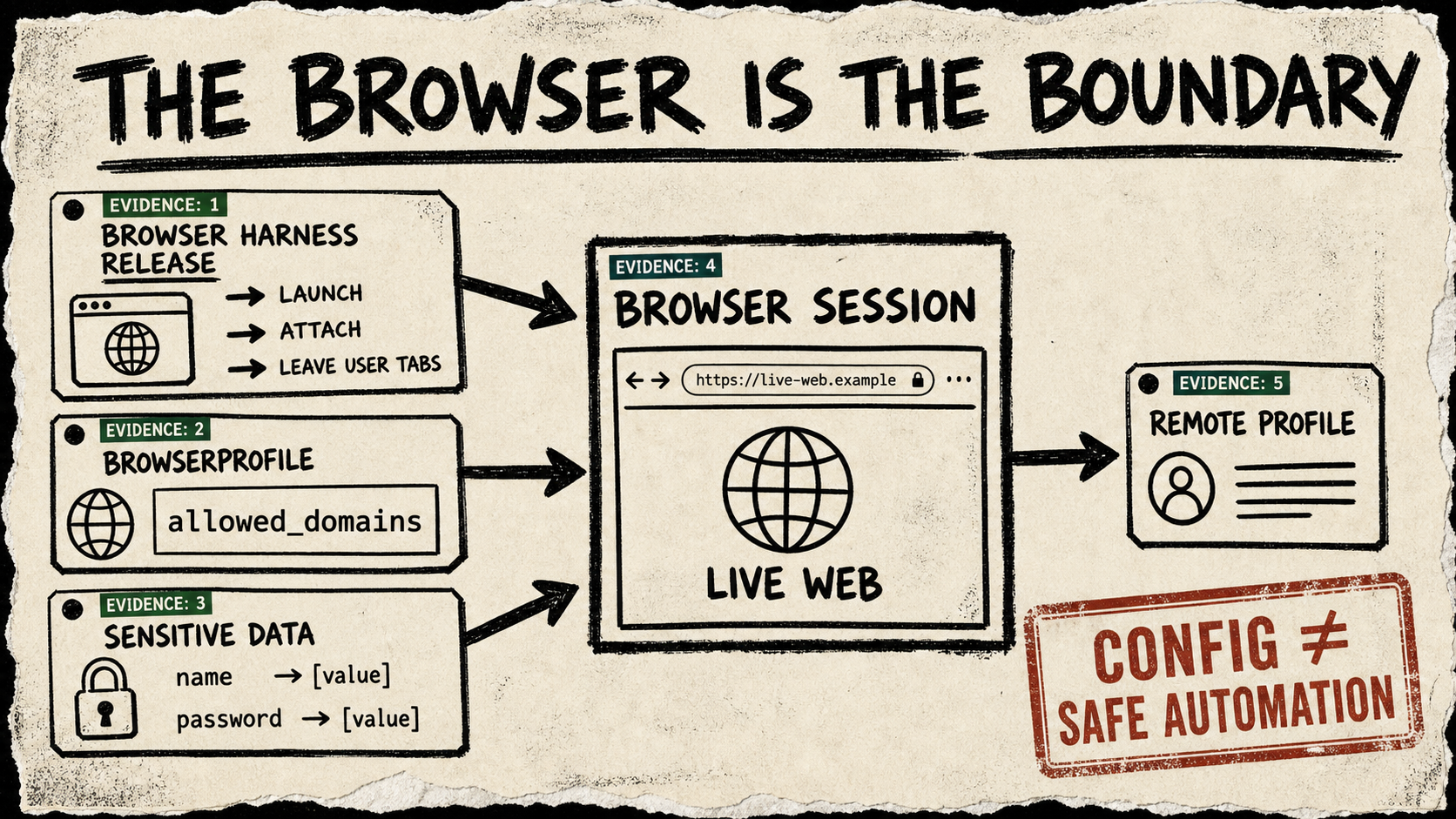
Browser Use’s latest harness release and its own session examples make a harder point than a benchmark: browser automation only becomes legible when profile, destination, and data authority are named controls.
More From This Edition
All editions ›Recent Editions
Full history ›Qwen Code Adds Edited Card Values to the Next Chat Message
The October 29 nightly lets applied values from an interactive answer accompany your next question. You can remove the attachment; the card’s calculated result stays separate.
Google’s Gemini API CLI Works Inside Other Coding Agents
Google has packaged its model and media services as shell commands that an existing agent can call. The practical choice is between changing the agent that runs your project and giving that agent another tool.
Hugging Face Links 3D Dataset Previews to Their Mesh Files
A newly merged dataset-viewer change pairs a flat picture with a retrievable 3D asset. It connects a quick look at a dataset row to the geometry behind it—while wider “3D” labels remain a separate capability.
Unsloth Connects Existing Fine-Tuning Scripts to Multiple GPUs
Supported training scripts can now divide model work across graphics cards through a launch setting. A later change reconnects training to generation and export—with a different memory requirement at each stage.
How AI Agents Work
The long-form map behind the daily paper: context, tools, loops, memory, delegation, safety, interface, and trust.