Daily Edition Sources +6

Agent Control Panels Move Into The Terminal

Hermes Agent, OpenClaw, and Codex all moved user-facing control surfaces closer to the agent runtime, from billing and provider setup to structured MCP prompts.

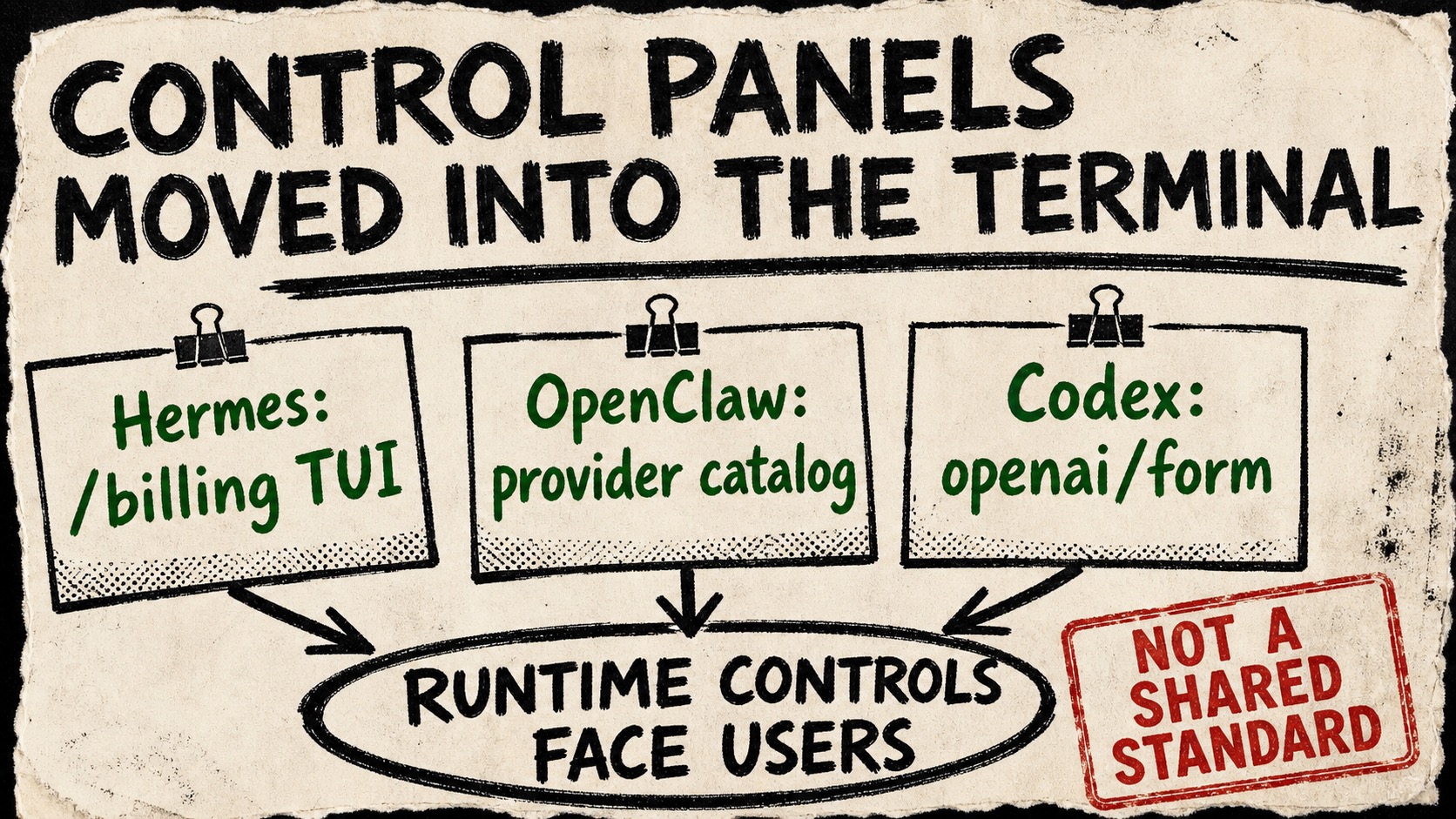
Diagram Punk poster showing Hermes billing, OpenClaw provider catalog, and Codex openai/form cards feeding into runtime controls facing users.
Diagram Punkterminal agents are turning runtime controls into user-facing surfaces.
repos NousResearch/hermes-agent + 2 more evidence
6 source signals 3 repos 3 linked commits
Evidence: 3 linked commits / June 19, 2026 / Daily Edition
Open Edition Evidence below

On June 19, NousResearch/hermes-agent merged commit 73cd8622f, adding a /billing terminal flow with CLI, TUI, gateway, auth, and tests.

Facts

  • Hermes added billing state, charge, auto-reload, scope step-up, portal-link, and polling paths across Python CLI code and Ink TUI screens.
  • openclaw/openclaw commit 21728777df externalized official provider and plugin catalogs while updating provider docs and install/auth helpers.
  • openai/codex commit 21a599fa56 let App Server clients opt into openai/form MCP elicitations.

Evidence

The shared movement is not one standard. It is a product pressure: agent clients are exposing operational choices that used to sit outside the loop as separate account pages, config files, or ad hoc prompts.

Context

For operators and builders, the practical question is who gets to see and approve runtime decisions: the model, the terminal user, the app client, or a provider catalog maintained outside the core loop.

Limits

The evidence does not prove coordination or equal maturity. It shows three public projects making control surfaces more inspectable as agent tooling moves from demos toward operated software.

Evidence Trail

Receipts below the story

The article above is the public narrative. This section keeps the source trail, limits, and reporting notes on the same page.

Edition
DateJune 19, 2026
LaneDaily Edition
Confidence87%
Sources6
ReposNousResearch/hermes-agent, openclaw/openclaw, openai/codex

Reporter Notes

The common pattern is user-visible runtime control, not a shared implementation.

Hermes makes money/account state part of terminal operation. OpenClaw makes

provider/plugin choice catalog-driven and installable. Codex makes structured

MCP prompts opt-in for App Server clients.

Primary Evidence

Evidence Limits

  • The article does not claim Hermes Agent, OpenClaw, and Codex coordinated or adopted a shared standard.
  • The public sources show implementation and protocol surfaces, not field adoption or production reliability.
  • Billing, provider catalogs, and structured elicitations are different mechanisms; the shared claim is limited to operational controls moving closer to user-facing agent sessions.
Letters & Corrections

Send a note to the desk

Corrections, missing context, or a follow-up lead.