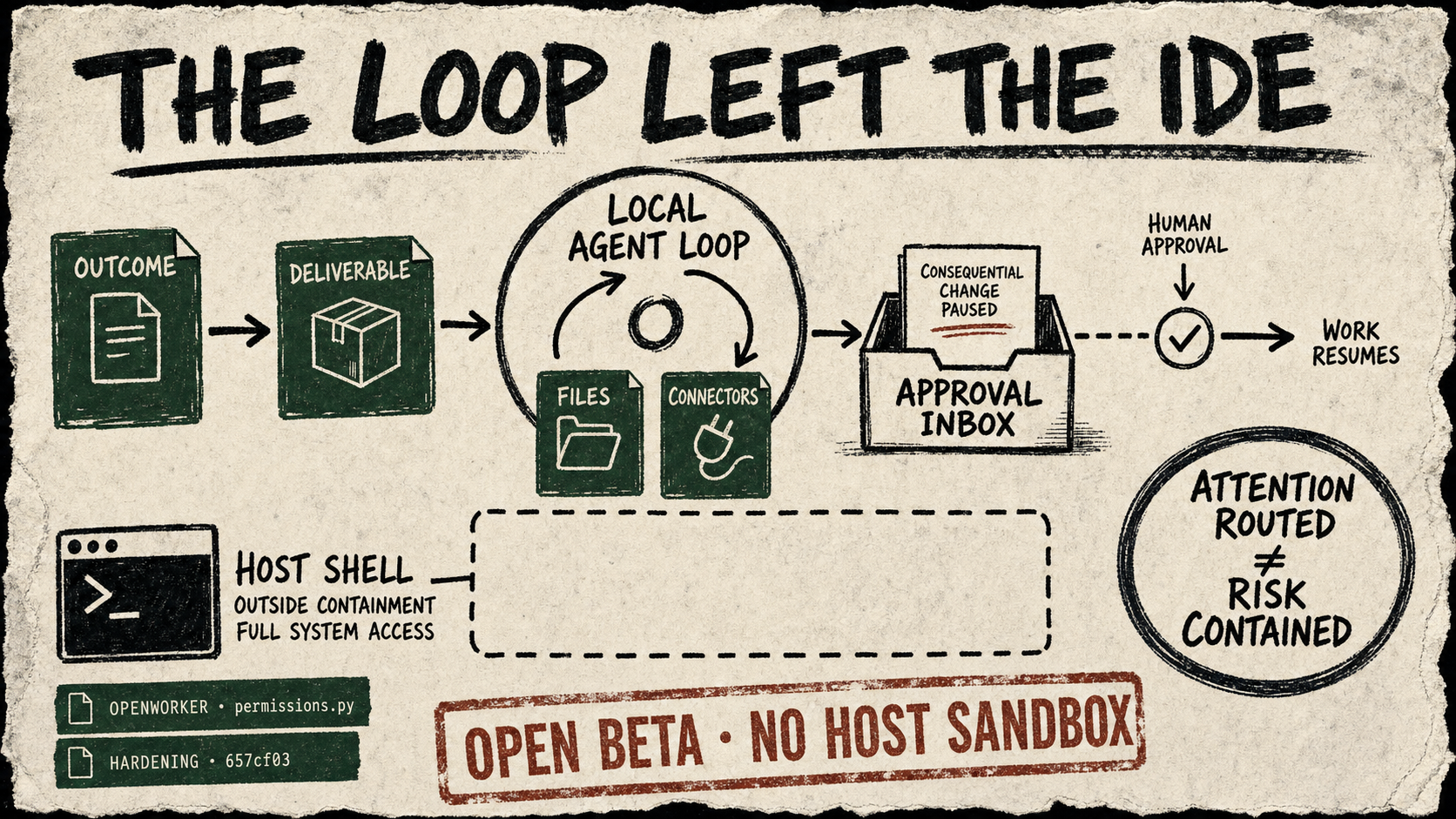
Andrew Ng’s launch post makes an intentionally ordinary promise: ask for a customer brief, a repaired calendar, a report, or a triaged Slack alert, and receive the finished work rather than another conversation about it. OpenWorker runs on the user’s computer, works across local files and connected services, lets the user choose an API model or Ollama, and asks before it does something consequential.
That sounds like a new coding agent only if “coding agent” now means the reusable machinery around one: an iterative model loop, scoped tools, a persistent workspace, permission gates, background work, and a way to resume after a human decision. OpenWorker does include a code persona with Git, shell, search, and file tools. But its main bet is larger. Ng and Rohit Prasad are taking the harness that made repository agents useful and aiming it at knowledge work that ends in a document, a sent message, or a changed calendar.
The distinction matters because it changes the product test. A code agent can leave a diff for review inside a version-controlled directory. A desktop coworker can cross several systems, expose private context to a model provider, and create effects that cannot be reverted with Git. OpenWorker’s most interesting design choice is an attempt to keep that broader loop moving without quietly raising its autonomy. Its largest unresolved issue is that the loop still executes on the host.
The authors, and the argument behind the launch
OpenWorker arrived with Ng’s reach, but it should not be read as a solo-author project. The announcement says Ng and Prasad are building it together, and the repository’s public contributor history makes Prasad’s implementation role visible. Ng brings a familiar public thesis. He founded DeepLearning.AI, leads AI Fund, and previously led Google Brain and Baidu’s AI group, according to his official biography. That history explains the audience for the launch; it does not substitute for reading the code.
The motivation is unusually well documented. Months before this release, Ng and Prasad described a small autonomous agent they had built on aisuite, their provider-neutral model interface. In Ng’s public account of that experiment, the simple loop was moderately capable and very unreliable. The lesson was not that one more prompt would fix it. Practical agents needed scaffolding.
Ng sharpened the product argument in a June issue of The Batch: desktop agents should be used as agents, not merely as chatbots. The difference was tool access to files, browsers, messaging, and applications, wrapped in permissions and guardrails. OpenWorker is the concrete answer to both claims. The model abstraction remains aisuite-shaped; almost everything around it is an effort to turn an unreliable loop into an inspectable work system.
The project was publicly launched on July 23, three days after GitHub’s repository metadata records its creation. Its README calls the product an open beta, and the rapid succession of early releases reinforces that label. The launch post said Windows support was coming; the repository now offers Windows builds while warning that they are unsigned. The useful reading is neither “finished platform” nor “weekend demo.” It is an unusually broad first public boundary, already changing under load.
Inside the loop: outcome, tools, risk, resume
The desktop application is a Tauri and React interface over a local Python service. That service assembles a turn engine from an agent persona, a model provider, file and shell tools, connectors, memory, scheduling, and optional MCP tools. The code persona is optimized for repository exploration, edits, tests, and Git. The cowork persona treats one or more user-selected folders as a knowledge workspace and pushes toward a deliverable.
At the center, the turn engine asks the model for tool calls, classifies them, authorizes each one, executes permitted calls, appends results, and continues. Read-only searches can run concurrently. Writes, shell commands, and external effects remain serialized. That is a sensible bias: parallelize inspection, but make consequential operations legible one at a time.
The permission engine separates discuss and plan modes, an interactive default, full-access auto mode, and a custom mode. It classifies operations as read, local write, execution, or external effect. File writes stay inside explicitly writable roots. Shell commands can be allowed for a session. Scheduled work may carry a standing rule for an exact external target, such as one tool acting on one named destination, but that mechanism deliberately does not grant standing permission to shell commands.
The repo changed beneath the launch story on July 24. A boundary-hardening patch replaced raw command-prefix matching with an argv-aware allowlist: it rejects shell operators and command substitution before checking an exact token prefix, and removes interpreters and package managers from the default allowlist. It also adds OAuth loopback state handling and caps WebSocket message and attachment intake. Those are meaningful reductions in accidental authority and cheap local resource abuse; they do not turn host execution into a sandbox or authenticate every local client.
That last distinction produces OpenWorker’s clearest original idea. In the source, “unattended” changes where the human is reached, not the autonomy ceiling. If an interactive run needs approval, the question appears inline. If an unattended or scheduled run reaches the same boundary, OpenWorker writes a durable Inbox item, suspends the agent, and waits. The approval can later arrive from the app or a configured channel, after which the run resumes.
This is more than notification polish. Many agent products collapse two different decisions—“keep working while I leave” and “do whatever you need”—into a single autonomy switch. OpenWorker keeps them orthogonal. Permission mode controls what the agent may do; unattended mode controls where blocked work waits for attention. Its Inbox uses stable session and tool-call identities and an idempotent pending-to-resolved transition, so a reconnect or duplicate reply should not execute the same decision twice.
Local-first is an architecture, not an isolation boundary
OpenWorker keeps conversations, workspaces, schedules, memory, audit records, and connector credentials on the machine. Users bring model-provider keys or select Ollama. A small cloud service brokers managed OAuth for some integrations, while manually configured credentials can keep the application signed out. The privacy claim is therefore specific rather than absolute: the control loop and state are local; data still leaves through the model providers and integrations the user chooses.
The model layer stands out for a different reason. Provider independence is structural, not a settings-page flourish: the same engine is assembled against aisuite-compatible providers. That lets OpenWorker compete on the harness instead of assuming one model vendor owns the whole product. It also makes evaluation harder. A broad provider menu creates more combinations of tool-call formats, context limits, latency, and failure behavior that the project must either test or explicitly bound.
Memory is similarly direct. OpenWorker stores explicit memories in SQLite with global, workspace, and session scopes, then makes relevant records available to the agent. That is inspectable and easy to delete, which is preferable to pretending an opaque embedding store is infallible. It is not yet a mature retrieval system: as memories accumulate, the project will need policies for relevance, expiry, conflicts, and how much old context enters a new decision.
The sharper limitation appears at execution. OpenWorker’s current executor runs an operating-system-native Bash or PowerShell process. Its own source says safety comes from approvals, timeouts, and best-effort non-interactive behavior, and names a future container or virtual-machine executor as the intended hedge. File roots constrain the project’s own write tools; they do not contain an approved shell process with the user’s operating-system privileges.
The local service deserves the same precision. It binds to loopback and rejects unapproved browser origins, but the inspected WebSocket session route does not require a per-install or per-session authentication token. An independent public issue has raised the resulting local-process threat. Origin checks help against a hostile web page; they do not authenticate another process already running as the user. For an agent capable of reaching shell, files, and connected services, that boundary needs hardening before “localhost” can be treated as trust.
Credential storage is also honestly early. The secret-store interface keeps values out of model prompts and restricts its JSON file to the user account, including Windows ACL handling. The file is still plaintext; the source explicitly leaves Keychain or an encrypted backend for later. An open beta can make that tradeoff. A desktop coworker that aggregates provider and connector credentials cannot leave it there.
What mature projects make visible
The fairest comparison is not a feature-count table. OpenWorker overlaps three established product shapes, and each reveals a different missing boundary.
OpenHands: a coding system with a runtime boundary
OpenHands remains purpose-built for software work: repository tools, an agent SDK and server, reusable components, and an evaluation culture tied to coding tasks. Its standard Docker runtime executes arbitrary code behind a client-server boundary, providing a consistent environment and resource isolation. Its security layer can also analyze actions and request confirmation.
OpenWorker is broader and more personal. It treats calendars, messages, documents, and scheduled routines as first-class outcomes, and its durable approval Inbox is more directly designed around a person leaving the app. But OpenHands shows what a mature coding-agent claim eventually demands: execution containment, programmable interfaces, repeatable benchmarks, and tests of task completion—not only a permission dialog around native execution.
OpenWork: a nearby desktop idea with a host model
OpenWork is the closest product comparison: an open desktop surface for doing agent work on local files, powered by OpenCode. Its architecture separates desktop client, orchestrator, server, and agent runtime; supports host and remote-client modes; exposes session events; packages reusable templates and skills; and has developed explicit machinery for debug exports, sidecar verification, and container-backed hosting.
OpenWorker differs at the center. It owns its Python agent engine rather than packaging an existing coding runtime, makes model independence a first-order choice, and treats everyday SaaS actions as part of the same loop. Its “unattended is attention routing” rule is also clearer than a generic background mode. OpenWork, however, demonstrates the operational surface that appears once a desktop agent becomes shareable: authenticated clients, verifiable sidecars, deployable hosts, export safety, and a boundary between interface and worker.
OpenClaw: a general assistant with explicit host-risk machinery
OpenClaw provides the broader personal-agent comparison: messaging surfaces, tools, sessions, scheduled work, and a large integration perimeter. Its sandbox is optional rather than universally on, so its defaults should not be romanticized. But the project has made the host-versus-sandbox choice explicit, and its execution approvals can bind policy to parsed command details such as executable, arguments, working directory, environment, and file identity.
OpenWorker has now made the allowlist less naive: its July 24 patch rejects shell operators and command substitution before applying an argv-aware prefix rule, and it no longer auto-allows interpreters. That is a concrete improvement over string matching. The remaining comparison is still useful: show the effective operation to the user, keep policy legible as commands grow more complex, authenticate the local control path, and pair approval with containment. OpenWorker’s advantage is a less sprawling desktop product and a strong outcome-first story; OpenClaw shows the security machinery accumulated when a general agent lives near real accounts for longer.
What stands out—and what must improve
OpenWorker already has a coherent answer to a problem many agents obscure: how can work continue without making human absence equivalent to unlimited permission? Durable suspension, a cross-session Inbox, exact-target standing rules for external actions, and serialized consequential tools form a credible design. The code and cowork personas sharing one engine also make the product thesis falsifiable. If the same harness can reliably produce a report and repair a repository, the agent loop really has become a general work primitive.
The next phase should be less about adding connector logos and more about proving the boundary:
- Contain execution. Ship the executor abstraction’s promised container or VM implementation, make the chosen boundary visible, and test what an approved shell command still cannot reach.
- Authenticate the sidecar. Add installation- or session-bound credentials to local HTTP and WebSocket control paths, not only origin filtering.
- Harden secrets and authorization. Move connector keys into platform key stores or encrypted storage, keep extending the new argv-aware policy rather than treating it as containment, and threat-model OAuth, prompt injection, and connector egress as one system.
- Publish reliability evidence. The repository contains backend, interface, and end-to-end tests, but users also need scenario evaluations: task completion, approval correctness, duplicate-effect prevention, recovery after restart, model-by-model behavior, and false confidence on partial deliverables.
- Narrow before widening. Large central server and connector modules make an ambitious beta harder to audit. Clearer component boundaries, typed contracts, coverage gates, signed builds, and honest per-connector readiness would be more valuable than another nominal integration.
The launch is worth attention because the project does not merely put chat beside a file browser. It has encoded a view of agency: outcomes over answers, local state over mandatory cloud custody, provider choice over model lock-in, and a human-attention queue instead of silent escalation. Those choices are meaningful even if OpenWorker never becomes the dominant desktop agent.
The next evidence to watch is not the star count. It is whether the team turns its open interfaces into hard boundaries: sandboxed execution, authenticated local control, encrypted secrets, reproducible evaluations, and public failure data across models and connectors. OpenWorker has taken the agent loop out of the IDE. Now it has to prove that the loop can live on a desktop without inheriting the whole desktop’s authority.