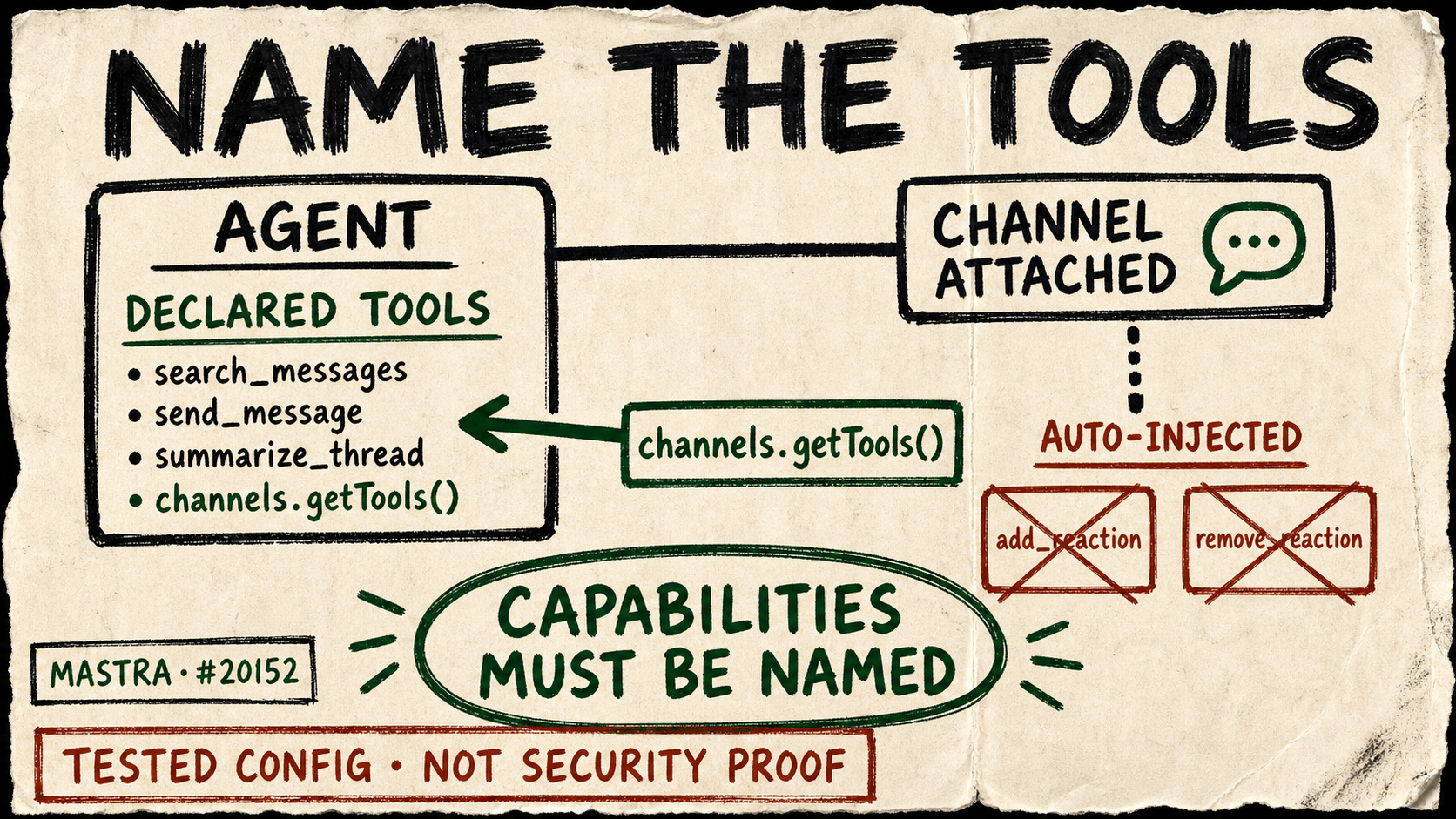
The most revealing change in a large framework is often the one that takes something away. On July 24, Mastra stopped automatically adding Slack-style reaction tools to an agent merely because the agent had channels attached. A developer who wants add_reaction or remove_reaction now has to add the output of channels.getTools() to the agent’s declared toolset.
The public change is not a dramatic safety announcement. It removes two reaction capabilities, corrects a documentation claim about a nonexistent sending tool, and adds tests. But its reason is unusually clear: attaching a channel silently mutated the resolved toolset. Replies did not need a tool at all; they already flowed through the channel output processor. The hidden extras were therefore both hard to see and largely unnecessary.
That is the right small problem for an agent framework to solve. In ordinary application code, a library that makes a configuration object quietly grant new effects is awkward. In an agent system, it is an audit problem. The model can only be evaluated, observed, and constrained against the surface its author can name.
From an agent loop to an application surface
Mastra describes itself as a TypeScript framework for AI-powered applications and agents. Its public repository groups together agents, graph-based workflows, memory, model routing, MCP, evaluation, storage, and observability rather than presenting one autonomous loop as the whole product. That combination is why the framework belongs in an application conversation, not simply a model-wrapper comparison.
The distinction becomes clearest when work has to wait. Mastra’s suspend-and-resume documentation treats a workflow pause as stored execution state: a step can wait for a human decision, an external callback, a cost boundary, or a timer, then return to the saved run. Its snapshot model names the information that must survive—step status, completed outputs, the path taken, suspended work, retries, and contextual data—and tells builders to make it serializable and keep it small.
Those are deliberately unglamorous primitives. They are also where a prototype becomes something an organization can operate. An agent that has access to a tool needs a declared tool list. A workflow that can pause needs a durable run identity. A model answer that changes a process needs a way to trace the prompt, tool calls, cost, and outcome. Mastra’s observability layer is designed around that application view: traces, logs, metrics, and feedback share correlation IDs so an operator can follow one request across agents, workflows, and tools.
Explicit tools are an operating discipline
The channel patch makes that broader architecture more believable because it chooses explicitness at the narrowest point. An agent can keep a channel configuration for inbound and outbound conversation without inheriting reaction actions. If the product needs reactions, the author writes the intent:
const channels = new AgentChannels({
  adapters: { slack: createSlackAdapter() },
})

const agent = new Agent({
  name: 'assistant',
  model: 'openai/gpt-5',
  channels,
  tools: { ...channels.getTools() },
})
That extra line is not bureaucracy. It gives a reviewer a stable question: which actions did this agent have when it made the decision? The implementation removes the old automatic injection from Agent.convertTools, while the channel tests now distinguish a channel-bearing agent with no reaction tools from one whose author opted in. The test proves the intended configuration contract, not that any particular Slack deployment is safe or reliable.
Mastra takes a similar hard-line approach in its evaluation vocabulary. Its public gates-and-verdicts guide separates a tracked score from a hard requirement: a gate has to score 1.0, while thresholds can report a miss without hiding it. That is a useful way to build agent software. “The agent usually calls the right tool” is a metric; “the agent must not continue without the approval tool” is a contract.
The boundary is technical and commercial
The framework’s open-source story also needs precision. Mastra’s README says the core framework and most of the repository are Apache-2.0, while directories named ee/ use a separate Mastra Enterprise License for production use. The boundary is visible in source, but it means an article about the repository cannot casually treat every capability mentioned in documentation or a monorepo tree as an open-source promise.
That caveat changes how to read the project’s ambition. Mastra is trying to make it normal for a TypeScript team to build an agent with the same kinds of artifacts it expects around a serious service: state, schemas, storage, traces, evaluation rules, and deployment choices. The recent channel patch does not prove that the framework has solved reliability, security, or deployment. It does show the design pressure is being applied in the right direction: a capability should arrive because an author declared it, not because it happened to be nearby.
The next evidence worth watching is whether that discipline holds at the harder boundaries—MCP actions, background workflows, human approvals, and hosted or enterprise components. A framework becomes infrastructure when an operator can answer, after the fact and before a failure, what the agent was allowed to do, what state it held, and how a test would catch a change in either answer.