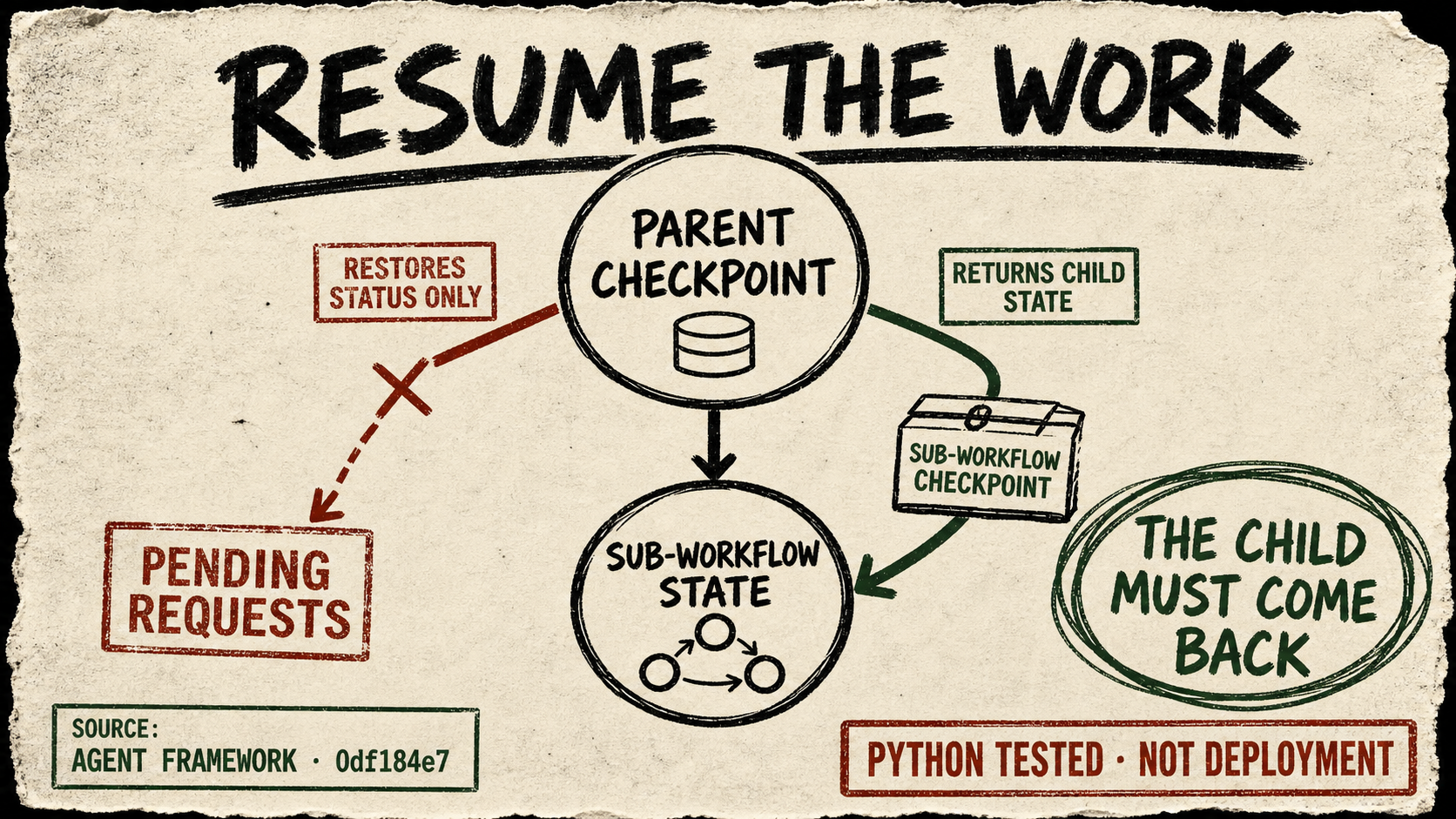
Microsoft Agent Framework’s July 24 commit in the public microsoft/agent-framework repo changed nested Python recovery: it now saves and restores a child workflow checkpoint with its parent. That concrete repair makes “resumable” a less generous word. A program can remember that work was pending, or it can continue the work actually under way after a restart; those are not the same promise when an agent workflow contains another workflow.
A July 24 repair in Microsoft Agent Framework’s Python package addresses that distinction directly. The change says a resumed parent workflow must restore each sub-workflow’s mid-progress state instead of merely replaying pending request information. It adds a nested checkpoint to the parent executor, plus regression tests for capture and restore.
That is a narrow implementation change, but it exposes a pressure that grows with every long-running agent system. Once a task can pause for an approval, an external callback, a rate limit, or a human answer, recovery is no longer an infrastructure afterthought. It is part of the product’s truthfulness. A user who approved a later step should not discover that the child process which needed the approval came back as a different, half-remembered job.
The parent had a receipt; the child needed one too
The framework already treats checkpoints as a first-class workflow concern. Its public code describes a runner that can capture a checkpoint object without persisting it, and a workflow executor that handles nested work. Before this change, the parent could recover its own envelope while a sub-workflow’s live state did not travel with it. The patch stores sub_workflow_checkpoint on save and restores it on load, retaining a backward-compatible reader for older checkpoints.
That wording matters. This is not a claim that every job has become durable in production. It is an explicit contract about what a particular recovery path intends to preserve. The accompanying sub-workflow tests and runner tests give the claim a useful shape: capture nested state, restore it, and make the resumed work see that state instead of reconstructing the situation from a loose list of events.
It also removes a misleading form of isolation. The commit notes that a sub-workflow is one shared instance, so per-execution bookkeeping never supplied real isolation. Request and response tracking now belongs to the sub-workflow that owns it. In practical terms, that is the difference between a parent keeping a notebook about a child and the child keeping its own passport.
Why agent builders should care before they add a resume button
Nested work is where an agent’s reassuring interface can drift away from reality. A top-level run may display “waiting for approval” while a child holds the model context, tool result, or request correlation that makes the next action safe. If a restart restores only the parent’s visible status, the system can look resumable while forcing the child to improvise, repeat work, or abandon a decision boundary.
The public executor change suggests a practical review question for any agent framework: when an orchestration contains subagents or sub-workflows, which object owns the durable state, and can a test prove that the object comes back intact? “We write checkpoints” is not an answer until it names the state each layer is allowed to recover.
There is a useful restraint in the patch, too. It warns about checkpoints taken while work is still pending and leaves checkpoint-less back ends unable to pretend otherwise. That is healthier than flattening the distinction into a universal “resume” badge. Storage, external side effects, model-provider calls, and non-Python implementations can still break a workflow’s continuity in ways this source does not test.
The next signal is therefore not a headline about durable agents. It is whether the framework publishes equivalent recovery tests for the places where a restart meets the outside world: tool calls, callbacks, timers, and duplicate-effect prevention. A checkpoint earns trust only when the work it claims to resume has somewhere precise to return to.