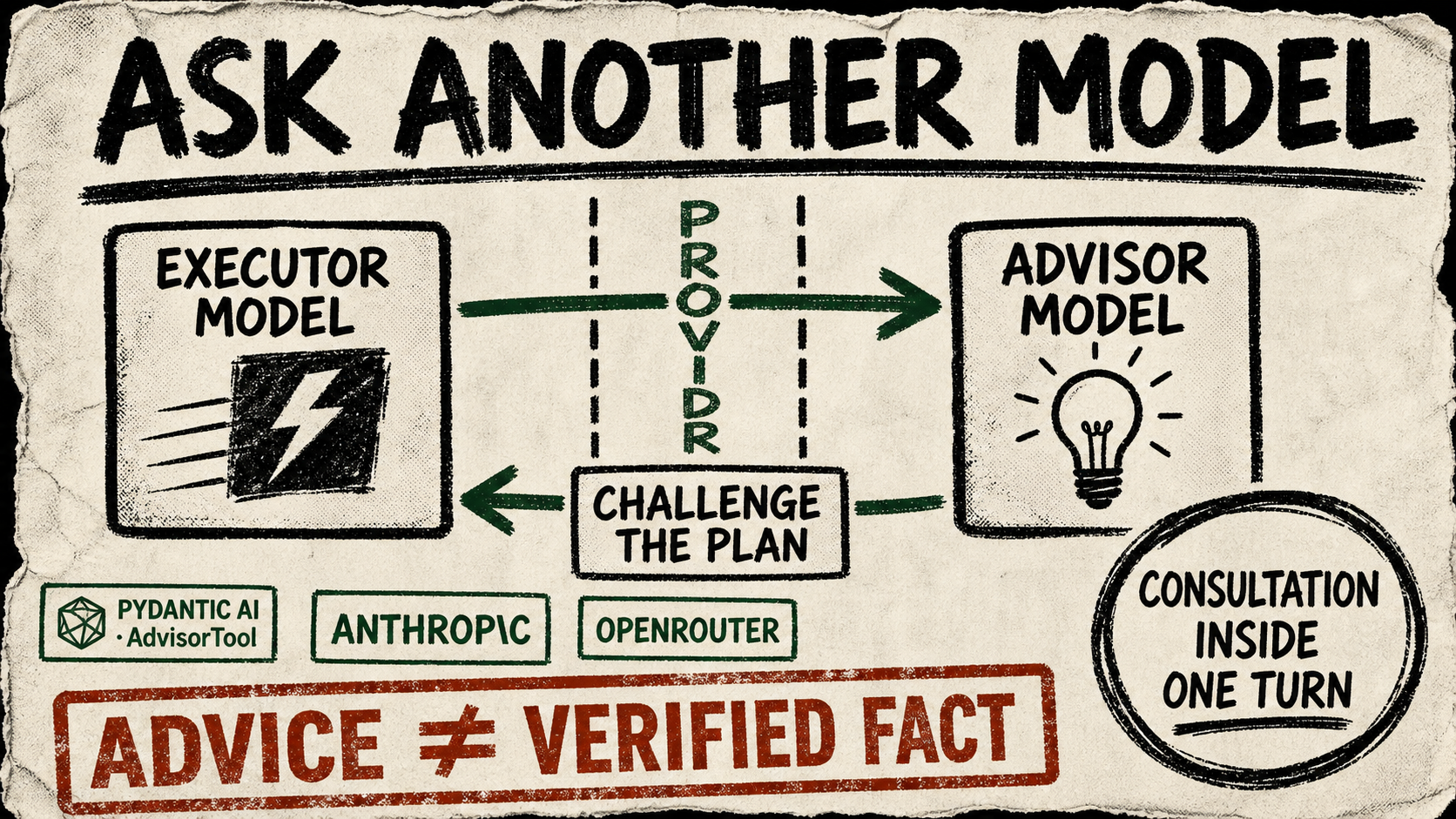
What changed: Pydantic AI’s new AdvisorTool support exposes a model-provider feature as an explicit agent capability. An executor model can consult a second model mid-generation; the provider runs that consultation and returns the result to the same turn. Anthropic and OpenRouter are supported. OpenAI, Google, and the other listed providers are not.
A useful split: execution versus consultation
This is not the same as writing a Python tool that calls another model. The public native-tools definition says these tools run in the provider’s infrastructure. That makes the integration a good fit for a bounded second opinion: let a relatively quick model draft a migration plan, then ask an advisor to inspect its assumptions before the executor writes the answer.
For an Anthropic-backed agent, the public example is compact:
from pydantic_ai import Agent, AdvisorTool
from pydantic_ai.capabilities import NativeTool

agent = Agent(
    'anthropic:claude-sonnet-5',
    capabilities=[NativeTool(AdvisorTool(model='claude-opus-4-8'))],
)

result = agent.run_sync(
    'Draft a cache-invalidation plan. Consult your advisor first, then name the riskiest assumption.'
)
Copy-paste instruction for an agent: “Use the provider-native advisor only to challenge the plan’s assumptions. Keep the final recommendation short, list what the advisor did not verify, and do not make changes or call external tools.” That keeps a consultation from masquerading as an autonomous review-and-act pipeline.
The implementation carries important differences. Anthropic can preserve advisor results in message history and reports advisor usage details; OpenRouter accepts any executor model but uses an OpenRouter catalog slug for the advisor, sends forward_transcript=false, and ignores max_uses and caching. The regression tests check that mapping rather than assuming the two providers share a contract.
Test caveat
This is a source-backed interface, not a free second brain. It requires valid provider credentials and compatible models; advisor calls have their own usage and cost behavior; streaming can pause while consultation happens; and this exact request was not executed in this run. A provider-side answer is still model output, not verified fact. Test it first on a reversible planning task, inspect the provider’s current access and compatibility rules, and make the executor name the evidence it would need before taking any consequential action.