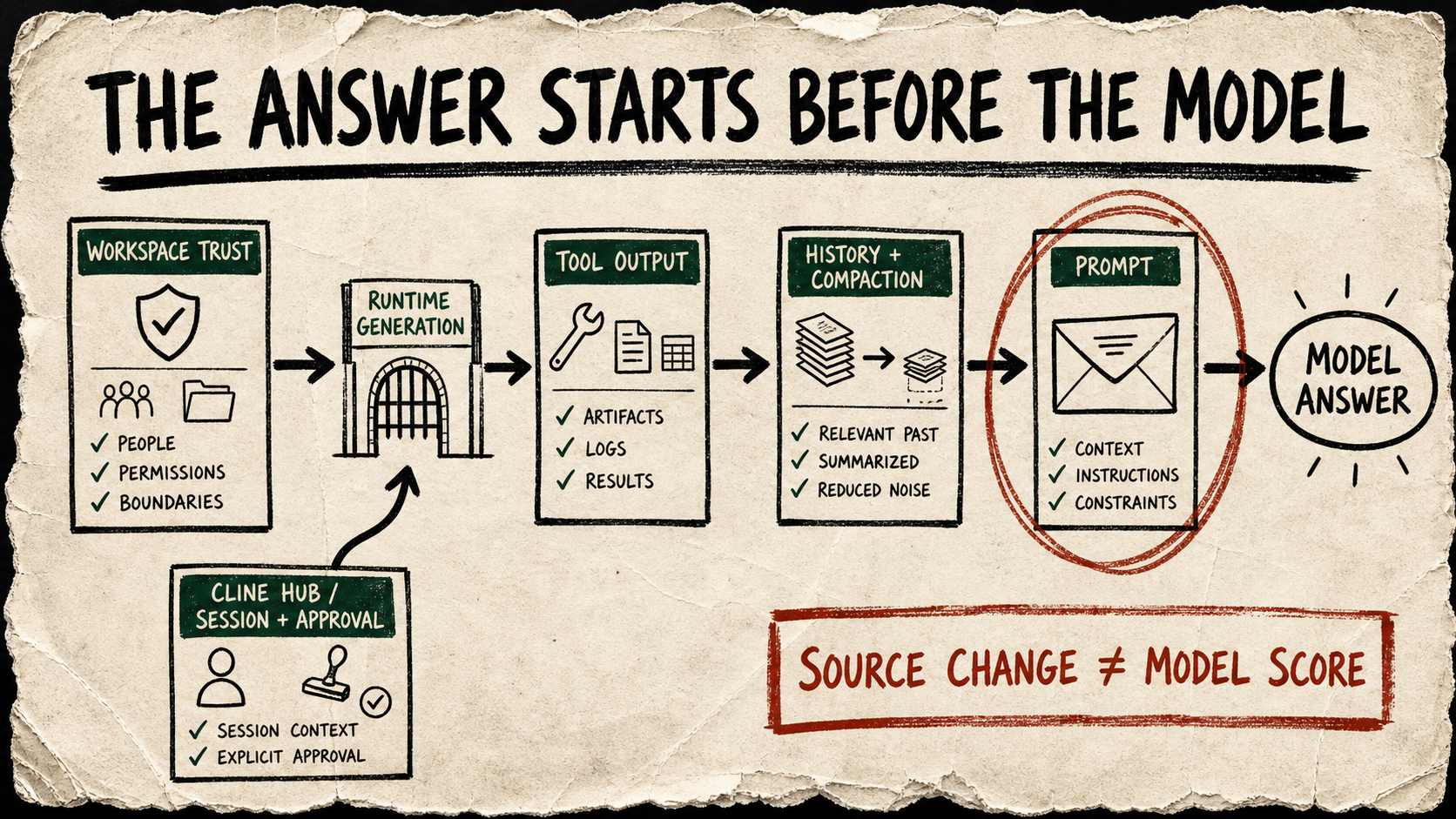
An Agent’s Answer Begins in the Harness
The model only sees the task after a runtime has edited its context, carried forward state, and decided what survived the last turn—so the first question after a bad run is what the harness made it see.
More From This Edition
All editions ›Before You Blame the Model, Inspect What the Harness Made It See
Cline: the supervised editor agent growing into an SDK and CLI
Mastra: turning TypeScript application primitives into agent infrastructure
Qwen Code: when an open model and coding agent evolve together
Recent Editions
Full history ›A Child Agent Can't Promise Its Watcher to the Parent
Hermes now makes a child wait, kill, or formally hand over background work before it returns—ending one treacherous kind of progress report.
A Computer-Using Agent Needs a Room, Not a House Key
OpenWork’s merged macOS 14+ preview gives a desktop-driving agent one person-approved window and a short-lived native session—a meaningful boundary, but not an operating-system sandbox.
No Mail Server Is Not a Free Pass
QM’s new admin-login route lets an already authorized administrator open a portal before outbound email exists—but only through a five-minute, origin-bound, one-use handoff that gets checked again at the door.
An Agent’s ‘No’ Needs a Way Back—But Not a Shortcut
Qwen Code now offers one manual review only for the exact action its AUTO mode blocked—turning a false positive into an accountable decision instead of a workaround hunt.
How AI Agents Work
The long-form map behind the daily paper: context, tools, loops, memory, delegation, safety, interface, and trust.