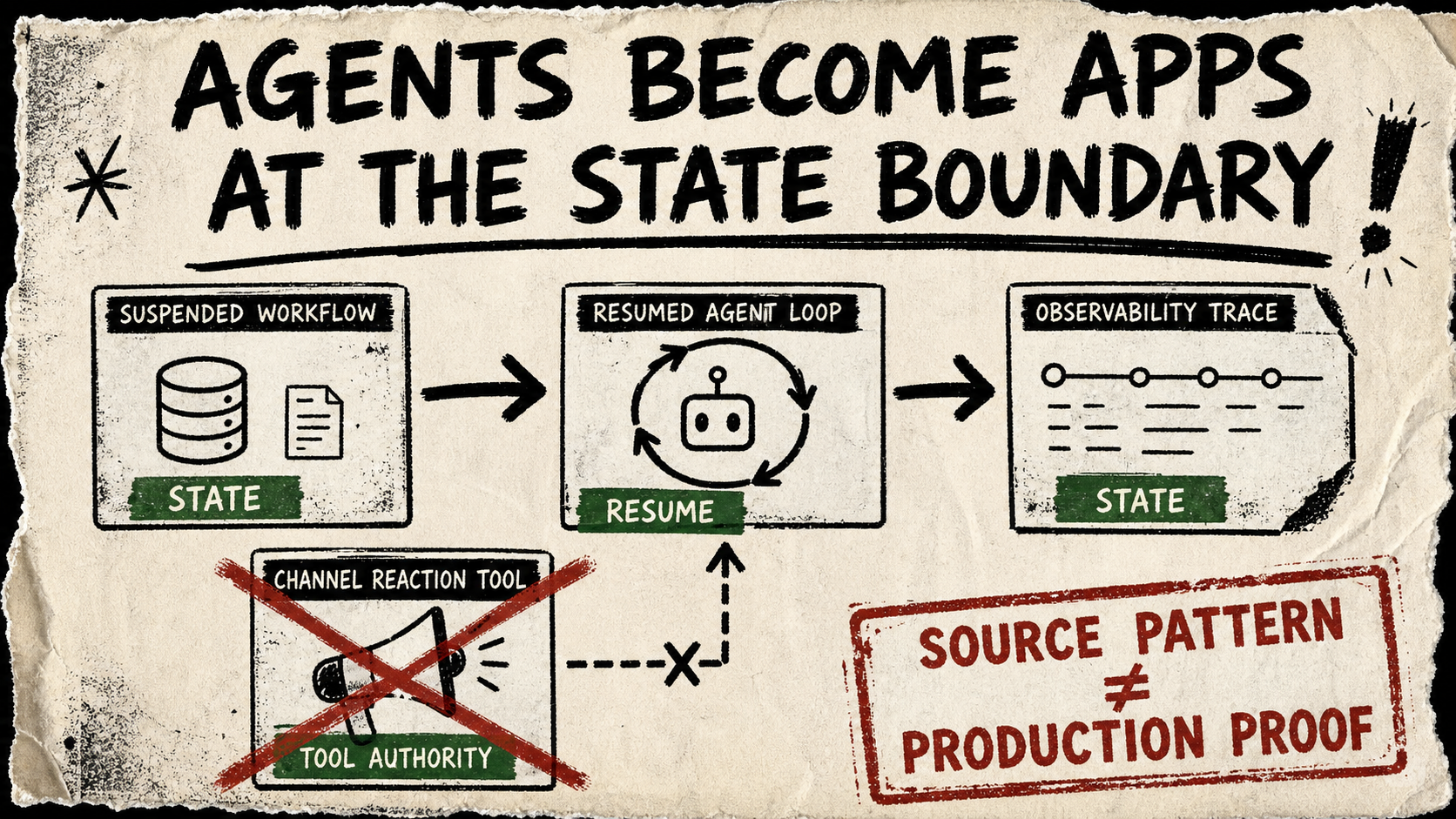
“Agent framework” can mean almost anything until a run stops halfway through a tool call. Does the next process know it is resuming rather than starting over? Can an operator tell which state is durable? Did a channel quietly give the agent a tool it was never meant to have? Mastra's public TypeScript source is interesting because it puts those questions beside agents and workflows instead of treating them as cleanup after the demo.
The core loop has a modest but important receipt: when a resume context includes a snapshot, it can recover suspended stream state before continuing. It also builds an observability context before executing the loop. Neither fact makes a system reliable by itself. Together, they show a framework treating an interrupted agent turn as application state that needs a record and a trace, not merely a chat transcript that hopes to continue.
Convenience is a control decision
A fresh July 24 channels change sharpens the point. It stops automatically injecting channel-reaction tools into agents. That is not a glamorous capability launch. It is a public choice to make a tool surface explicit rather than inherit it because an agent happens to be connected to a channel. In an application, ambient power is hard to test and harder to explain after an incident.
Mastra's workflows package gives the surrounding design its shape. Workflows, suspension, resume inputs, and a tracing context are all places a developer can express what a long-running piece of work is allowed to remember and how it can restart. The project is not promising that every workflow is durable by default; the source makes the boundary available for the application to own.
Make the handoff inspectable
That is the transferable engineering lesson. At every agent-tool boundary, write down the state snapshot, the resumption rule, the observation record, and the authority that can add a tool. Then test an interruption that happens between those steps. The point is not to eliminate surprise from a model. It is to prevent a restart from becoming an undocumented new run with old-looking output.
The strongest challenge to Mastra's production-ready framing is the source itself: public code can show a design but cannot tell us that a customer deployment, evaluation, enterprise module, or live provider configuration behaves as intended. The article therefore makes no such claim. The next proof should be a public integration test that suspends work across a tool boundary, resumes it in another process, and leaves a trace an operator can audit.
This is late work against the original July 25 commitment, not an on-time substitute. The useful next signal is a released, reproducible recovery exercise—not another abstract list of agent framework features.