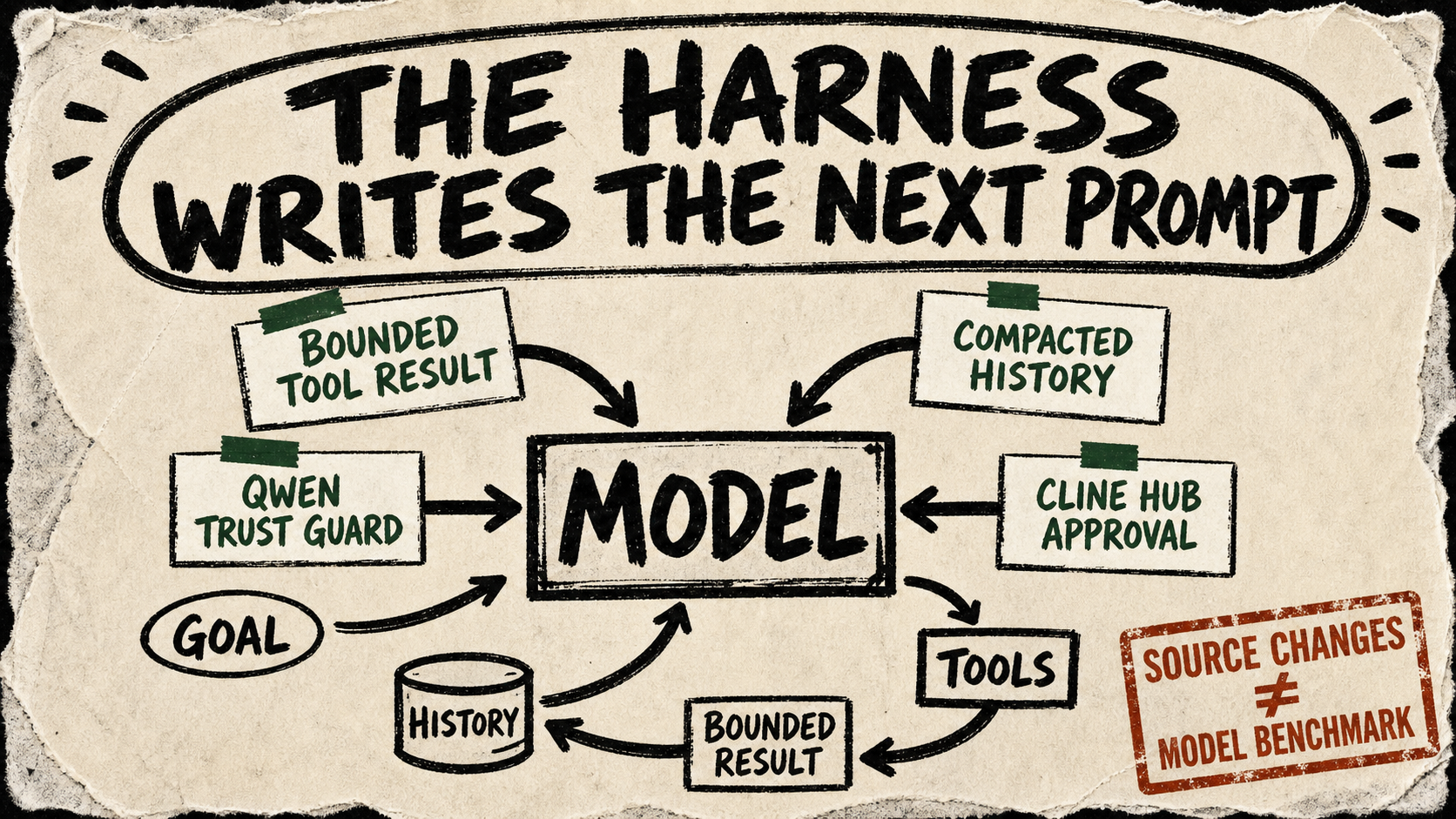
When an agent forgets a task after a long command, picks the wrong tool, or stalls after compaction, “the model failed” is the fastest diagnosis. It is often not the first one worth making. In a public account of building an open-model harness, Parth Sareen makes the awkward point plain: the next model call may contain mostly stdout, a vague summary, a changed prompt prefix, or a tool result too large for the remaining context. That is not background plumbing. It is the environment in which the model is being asked to work.
The useful correction is not that every weak result is a harness bug. It is that a run has a chain of custody. Before a model answers again, someone has chosen its tool schema, bounded a result or not, retained or rewritten history, carried forward a permission decision, and decided what survives a failed turn. If those choices are invisible, a model comparison can quietly become a comparison of two different jobs.
The run has policy in it
Qwen Code's July 25 workspace-trust change is a useful receipt because it is not framed as model quality at all. The public commit rebuilds workspace runtime generations when trust policy changes, makes affected daemon routes fail closed, and adds tests around the policy monitor, reconciliation, and generation boundary. The claim is deliberately narrow: this source shows a team treating trust changes as a change to the running environment, not as a setting that can safely drift underneath an in-flight task.
Cline makes a different part of the same problem visible. Its SDK architecture separates a stateless agent loop from stateful orchestration, then gives a shared Hub responsibility for sessions, approvals, schedules, and host capabilities. A recent desktop change moves chat through that shared Hub instead of owning a private in-process runtime. The public design routes an approval back to the client that created the session. That is not a promise that every client surface is equally safe; it is a source-visible answer to who owns a decision when the same run has more than one doorway.
Ask for the request, not the vibes
The freshest cross-project lesson is a reporting discipline, not a standard. Goose publishes context-management and compaction material; Gemini CLI has public context-compression paths. Neither proves that it behaves like Qwen Code or Cline, and none proves a model's score. But they make the absent object easier to name: the exact request shape after a tool call, a truncation marker, compaction, a policy change, or a recovery attempt.
For builders evaluating a model swap or local-to-cloud handoff, the first artifact to request should be a trace that answers five unglamorous questions: what was in the next prompt; what was omitted; whether the omission was declared; which permission and workspace state persisted; and what happened after a failure. A clean trace can exonerate a model. It can also reveal that the model was asked to reconstruct a task from evidence the harness had already thrown away.
These commits and documents do not establish released behaviour, production reliability, or a shared model-portability contract. The next serious signal is a reproducible task-matched comparison that records bounded output, compaction, permission state, and recovery—not another leaderboard with the run hidden behind it.