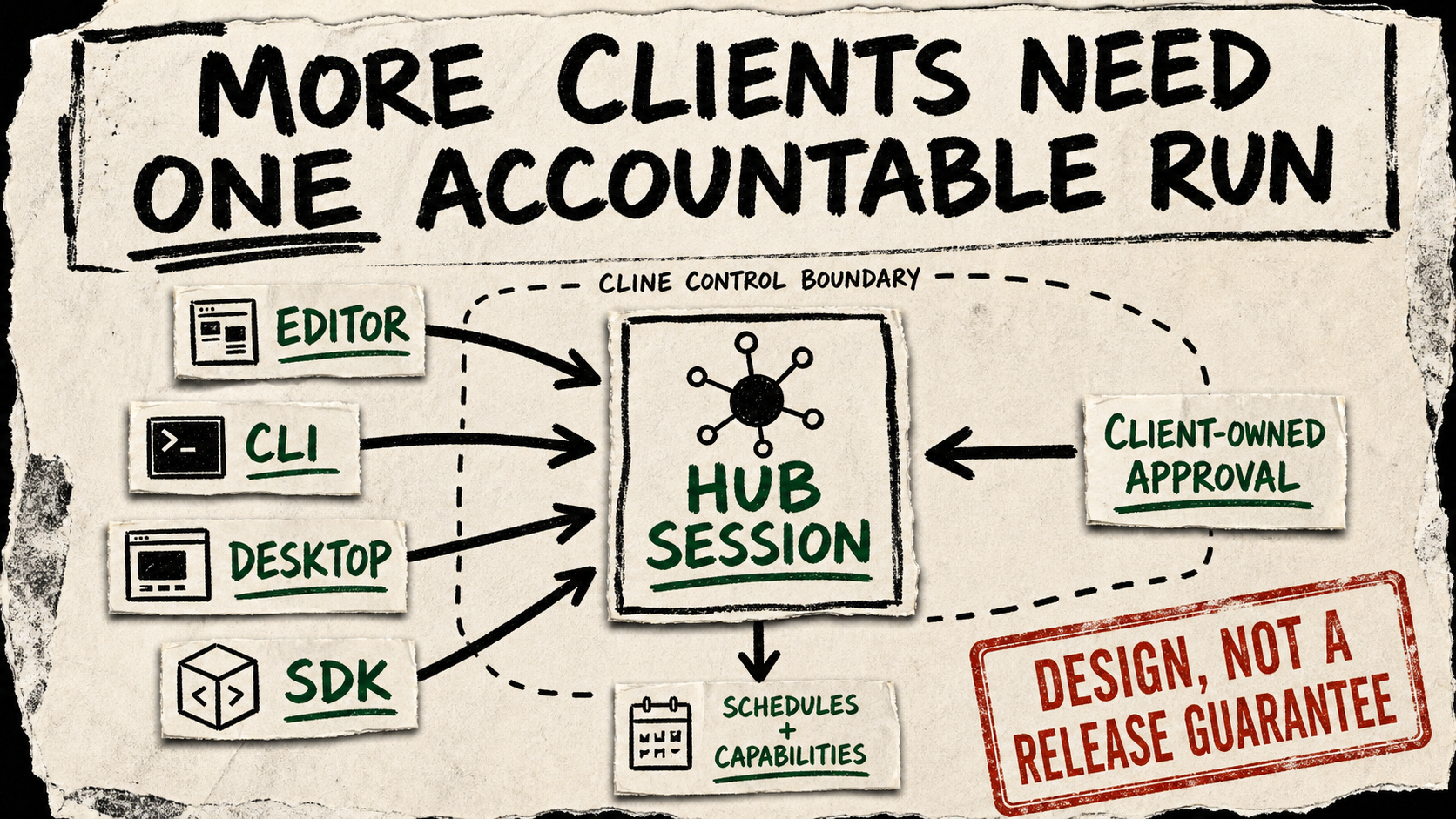
A coding agent is easy to supervise when it lives in one editor pane. The contract becomes harder to see when the same work can arrive from a CLI, a desktop app, an SDK host, a schedule, or a connector. Cline's public source is now explicit about that pressure. Its SDK architecture puts the stateless agent loop in one layer, stateful orchestration in another, and sessions, schedules, approvals, and host capabilities behind a shared Hub.
That is a more consequential change than a new packaging option. A user needs to know which running authority holds a task's state, which client can answer an approval request, and whether closing one surface ends the work or merely disconnects a viewer. Cline's source makes those questions part of the runtime contract instead of leaving every host application to invent an answer.
The desktop stops pretending it is alone
The July 23 desktop change gives that design a concrete receipt. Its sidecar no longer owns a private in-process agent runtime. It discovers or starts a compatible shared Hub, registers as a client, and sends chat through the common runtime. The accompanying architecture notes say that concurrent clients should converge on one Hub; a host attaching to a shared session does not automatically stop the authority runtime when it detaches.
The safety detail is in the return path. The public implementation describes a Hub that routes an approval request back to the client that created the session. The desktop then presents the request and resolves it locally. That is a useful division of labour: the session authority can remain shared without making approval a free-floating global button. It also gives an integrator something testable: an approval should be attributable to the session and client that asked for it.
One architecture, several modes
The first optimistic angle—“Cline has centralized supervision”—does not survive unchanged. The same architecture says interactive CLI startup may use an already compatible Hub but can fall back to a local runtime for responsiveness. Cline also has a public chat-without-workspaces path in which the execution runtime resolves the shared chat workspace. Those are sensible compatibility choices, but they mean an operator cannot infer one universal control plane merely from the brand of the client.
The durable lesson is for anyone turning an editor agent into a platform: map authority before adding surfaces. Name the session owner, the durable store, the capability provider, the approval return path, and the rule for a disconnected client. A shared runtime can make work more resumable and observable; it can also hide where a decision was made unless the product keeps those seams public.
Cline's public source proves an architecture and targeted implementation work. It does not prove a particular release, hosted-service policy, user adoption, or safety under every provider, disconnect, and recovery path. The next useful receipt is an end-to-end public test with two attached clients, an approval, a disconnect, and a visible survivor.